Contents
SecureGate
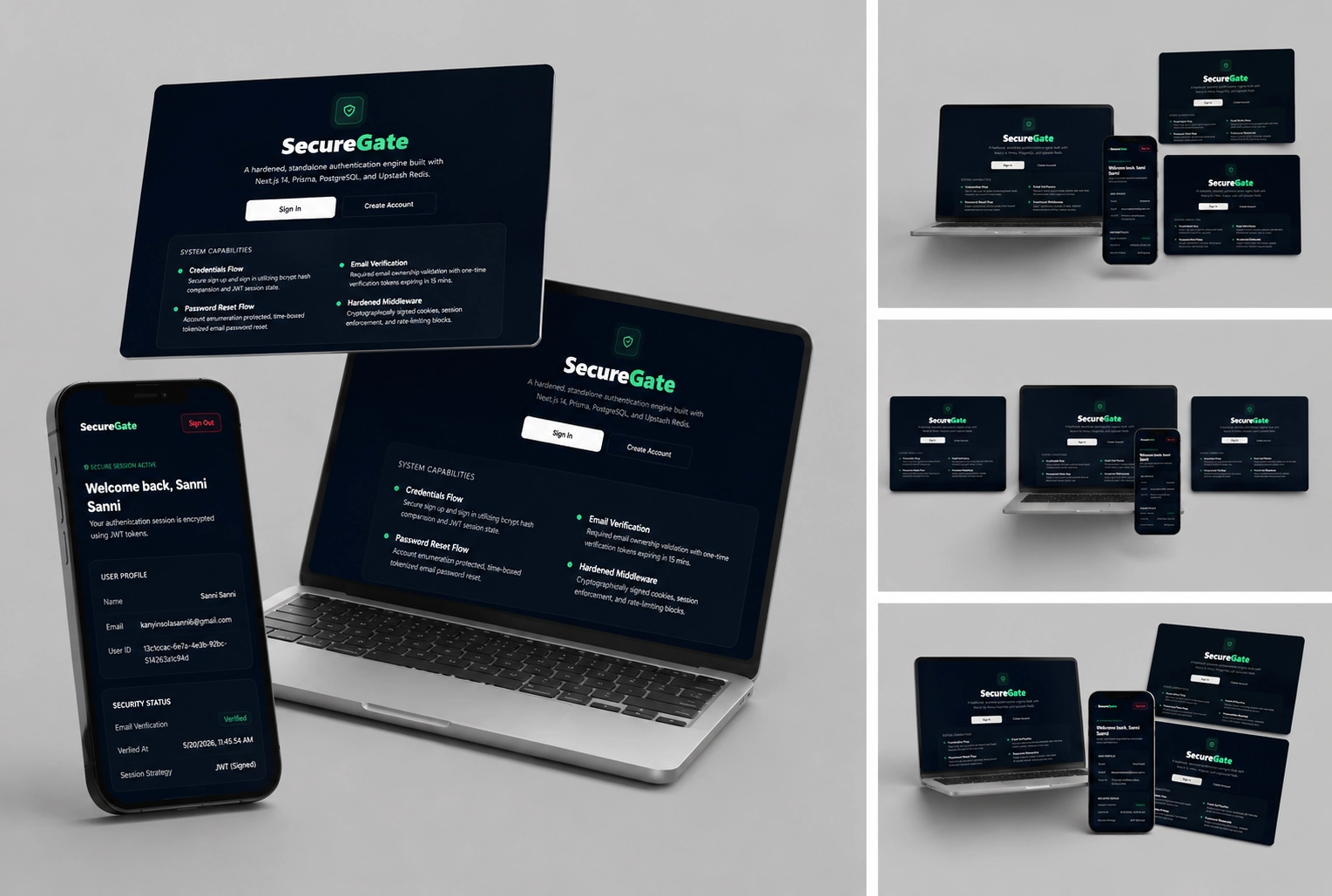
Production-ready authentication system engineered with Next.js, Prisma, NextAuth.js and PostgreSQL. Built with secure authentication, email verification, password recovery, protected routes and production-grade security practices.
Overview
SecureGate is a production-ready authentication system built to demonstrate secure identity and access management using modern web engineering practices. Rather than building a full application, the project focuses exclusively on designing, implementing, and securing the authentication layer that powers real-world products.
The application provides secure user registration, email verification, password recovery, protected routes, JWT-based session management, and brute-force protection through rate limiting. Every authentication flow was designed with security-first principles, ensuring user credentials, sessions, and sensitive operations are protected against common attack vectors.
The Challenge
Authentication looks simple on the surface, but behind every sign-up and login flow lies a complex security system responsible for protecting identities, sessions, and sensitive data.
A production-ready authentication system must defend against multiple attack vectors while remaining intuitive for legitimate users.
Password Leaks
Improper credential storage can expose user accounts.
Session Hijacking
Stolen sessions can grant unauthorized access.
Brute-force Attacks
Repeated login attempts may compromise weak accounts.
Expired Tokens
Poor token management creates authentication vulnerabilities.
Email Verification
Unverified identities reduce trust and enable abuse.
Password Recovery
Weak reset mechanisms can become attack vectors.
System Architecture
How every authentication request flows through SecureGate's layered security pipeline.
SecureGate follows a layered architecture where every incoming request passes through strict validation, secure credential handling, database verification, and session management before any access is granted.
By decoupling authentication into modular checkpoints, the system remains highly scalable and robust against common vulnerabilities like brute-force attacks and session hijacking.
Security First
Every request is validated before access is granted.
Layered Validation
Authentication passes through multiple security checkpoints.
Scalable Architecture
Each layer is modular, making the system easier to extend and maintain.
Security First
Every request is validated before access is granted.
Layered Validation
Authentication passes through multiple security checkpoints.
Scalable Architecture
Each layer is modular, making the system easier to extend and maintain.
Authentication Flow
From account creation to a fully authenticated session, every step is designed to verify identity, establish trust, and protect user data.
- ■Email validation
- ■Password policy
- ■Duplicate check
- ■One-time token
- ■Expiration
- ■Activation
- ■bcrypt verification
- ■Credential validation
- ■Signed token
- ■Secure session
- ■Auto expiration
- ■Middleware
- ■Authorization
- ■Session validation
- ■Protected route
- ■Private data
- ■Authenticated state
Engineering Decisions
Every security mechanism in SecureGate exists to solve a specific engineering problem.
Brute-Force Protection
Authentication endpoints are vulnerable to credential stuffing and brute-force attacks.
Implemented Upstash Redis rate limiting using a sliding window algorithm.
Repeated login attempts are automatically throttled, reducing attack surface without blocking legitimate traffic.
Server-Side Input Validation
Client-side validation can be bypassed by malicious actors manipulating network requests.
Implemented strict server-side validation using Zod schemas for all authentication endpoints.
Malformed data and malicious payloads are rejected before reaching the database or processing logic.
Password Hashing & Storage
Storing passwords in plain text creates a critical security risk if the database is breached.
Every password is cryptographically hashed using bcrypt with 12 salt rounds before storage.
Passwords remain protected and mathematically infeasible to reverse-engineer even if data is exposed.
Secure Password Recovery
Password reset links without expiration can be exploited if intercepted or reused months later.
Generated unique, cryptographically random password reset tokens with a strict one-hour expiration.
Tokens become useless shortly after creation, and are invalidated immediately upon first use.
Technology Stack
The technology stack was intentionally selected for scalability, security, and production reliability.
Frontend
Backend
Database
Authentication
Security
Infrastructure
Lessons Learned
Building SecureGate changed how I think about authentication—not as a feature, but as the foundation of application trust.
Security by Design
Authentication should be designed into a product from day one, not retrofitted later.
Never Trust Client Input
Every piece of user input should be validated on the server regardless of frontend validation.
Small Decisions Matter
Small implementation details compound into stronger security and better user trust.
"SecureGate taught me that great authentication isn't built by adding security features—it's built by making security a core engineering principle from the very first line of code."