Contents
MedQuire
An AI-powered medication companion that transforms complex prescription information into clear, personalized guidance—helping patients understand, manage, and use their medications safely with confidence.
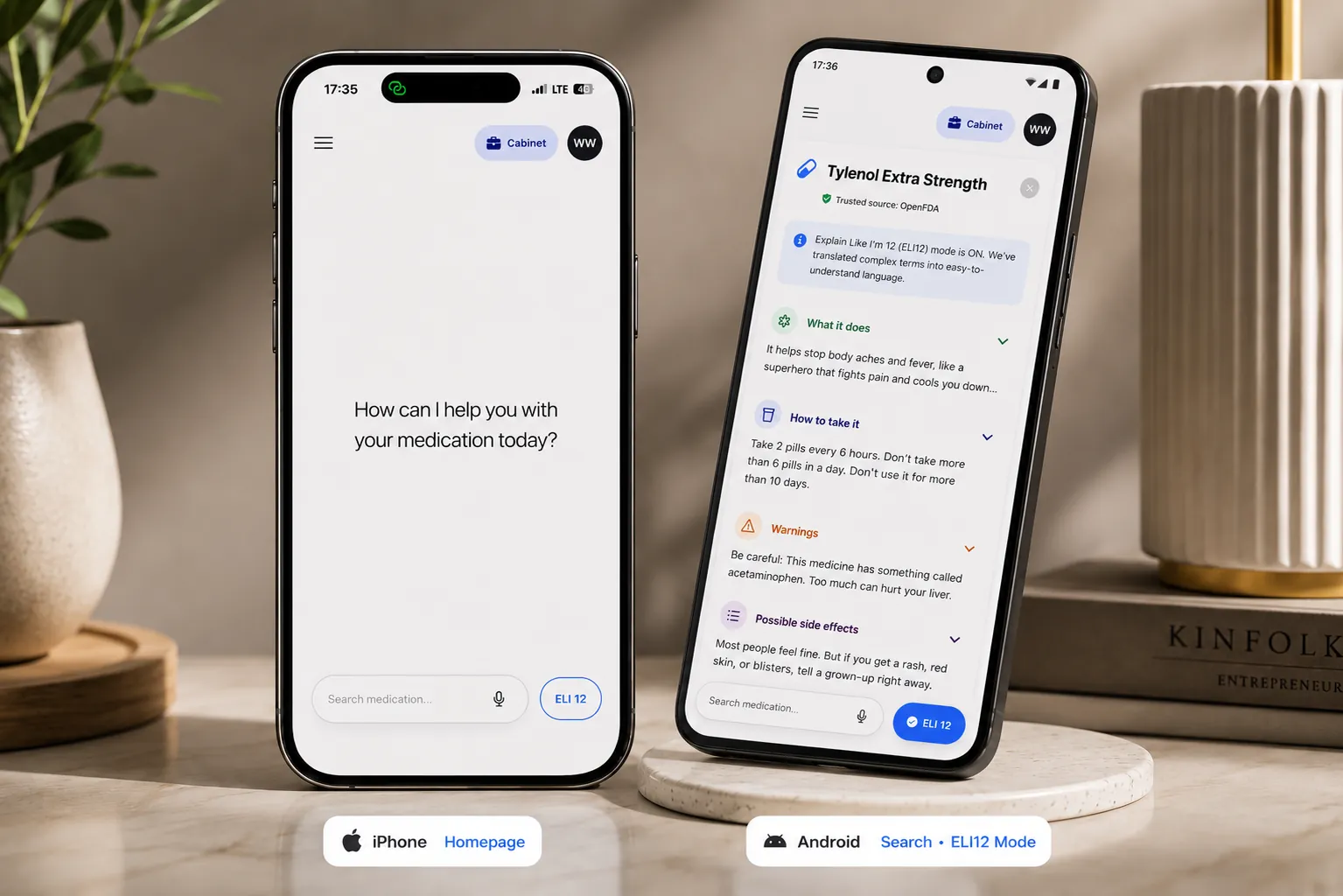
About MedQuire
Every day, millions of people receive prescriptions containing instructions, warnings, side effects, and medical terminology that can be difficult to understand without professional guidance. While pharmacists explain medications during consultations, those explanations are rarely remembered once patients return home.
MedQuire is an AI-powered medication companion that transforms complex medication information into clear, everyday language. Beyond simply simplifying jargon, MedQuire enables users to check potential drug interactions, ask follow-up questions through an AI-powered assistant, and generate exportable summaries for caregivers.
Rather than diagnosing conditions or replacing doctors, MedQuire was designed to improve medication literacy by making trusted medication guidance more intuitive.
Why MedQuire?
Transforms complex prescription information into simple, trustworthy guidance while helping users understand medications more confidently.
My Contributions
Throughout the project, I contributed across both product design and engineering to bring MedQuire from concept to a functional mobile application.
Product Design
Led product discovery, synthesized user research, designed user flows, and iterated on interface components.
Product Engineering
Bootstrapped the React Native/Expo architecture, implemented the Context API for state management, integrated the DeepSeek AI and OpenFDA APIs, and built out core front-end features.
The Challenge
Healthcare information is only valuable when people can understand it.
Prescription labels, medication guides, and warnings often contain technical terminology designed for medical accuracy rather than everyday comprehension. For individuals managing chronic illnesses, older adults taking multiple medications, or first-time prescription users, this communication gap creates unnecessary uncertainty and anxiety.
Our primary design challenge was clear:
"How might we help people better understand medication information in language they can easily grasp—without replacing the guidance of healthcare professionals or compromising medical accuracy?"
Research & Discovery
Before designing a solution, we combined user conversations, personal observation, and desk research to identify the real communication barriers people encounter with prescription medications.
Patients rely heavily on verbal explanations
Once they leave the pharmacy, that easily-digestible information is gone.
Medical terminology creates barriers
The challenge wasn't a lack of information, but a lack of comprehension.
Simplicity builds confidence
Users didn't want medical encyclopedias; they wanted quick, trustworthy answers to feel safe.
Understanding is an ongoing process
People often think of new questions later (e.g., "Can I take this with another pill?").
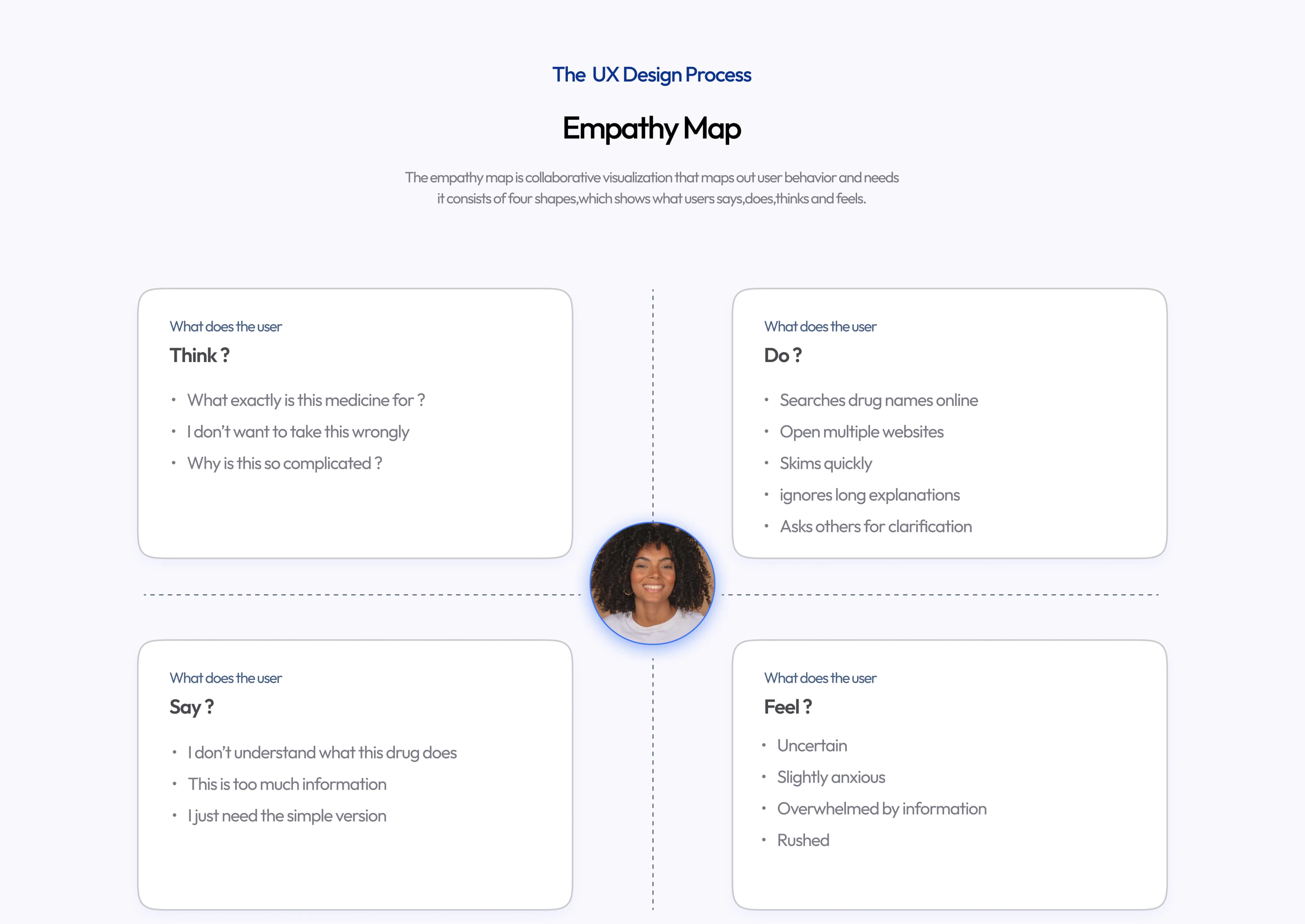
Empathy Mapping
Synthesizing user interviews to deeply understand the emotional and practical hurdles patients face when managing their medications. This informed our compassionate tone.
Research Takeaway
"Our research revealed that the problem wasn't access to medication information—it was understanding it. Users needed trusted medication guidance presented in simple, everyday language."
Target Users
Based on our research, we identified several groups who could benefit from a more accessible medication experience. Although these groups have different goals and healthcare needs, they all share one common challenge: understanding medication information shouldn't require medical training.
Primary Users
Direct end-users of the product
- Adults managing prescription medications.
- Individuals living with chronic illnesses.
- Older adults taking multiple medications.
- People with limited health literacy.
- First-time prescription users.
Secondary Users
Caregivers & support networks
- Parents managing medications for children.
- Family caregivers.
- Individuals supporting older relatives.
- Anyone seeking a simpler explanation of medication information.
Primary Users
Direct end-users of the product
- Adults managing prescription medications.
- Individuals living with chronic illnesses.
- Older adults taking multiple medications.
- People with limited health literacy.
- First-time prescription users.
Secondary Users
Caregivers & support networks
- Parents managing medications for children.
- Family caregivers.
- Individuals supporting older relatives.
- Anyone seeking a simpler explanation of medication information.
Competitive Analysis
During our research, we analyzed existing medication management and drug information platforms to understand where users still struggled. While these products provide trusted medical information and medication management tools, we identified an opportunity to make medication guidance more understandable through AI-powered, plain-language explanations.
AI-powered plain-language explanations
Medication interaction checker
Personal medicine cabinet
AI follow-up questions
Exportable medication summaries
Trusted medication database
Why MedQuire Stands Out
"Our research showed that existing solutions focused on storing medication information or presenting comprehensive medical references. MedQuire was designed to bridge the communication gap by translating complex prescription information into clear, personalized guidance powered by AI."
Product Strategy & MVP
Our research shifted our perspective drastically. We realized that simply aggregating data wasn't enough.
We weren't solving an information problem—we were solving a communication problem.
We chose to leverage Artificial Intelligence—specifically the DeepSeek API combined with the trusted OpenFDA database—not to generate medical advice from scratch, but to act as a translation layer that makes existing, trusted information more accessible.
To validate this approach quickly, we defined a focused Minimum Viable Product (MVP) centered around core literacy features.
Define the MVP
Use research findings to determine which features would provide the greatest value during the first version of the product.
Product Principle
"Research wasn't treated as a standalone activity. It became the foundation for prioritizing features, defining product scope, and shaping the overall user experience."
Research Insights
Understanding user pain points and communication barriers.
Prioritization
Identify the features with the highest user value.
MVP Definition
Focus on the smallest feature set capable of solving the core problem.
Product Experience
Deliver a simple, trustworthy medication companion powered by AI.
MVP Features
To validate our product strategy, we focused on six core features that solved the biggest communication challenges patients face when understanding and managing medications.
AI Medication Translator
Users search for a medication and receive a rewritten explanation in clear, everyday language, preserving the original medical meaning.
- Clear explanations
- Medical accuracy
- Everyday language
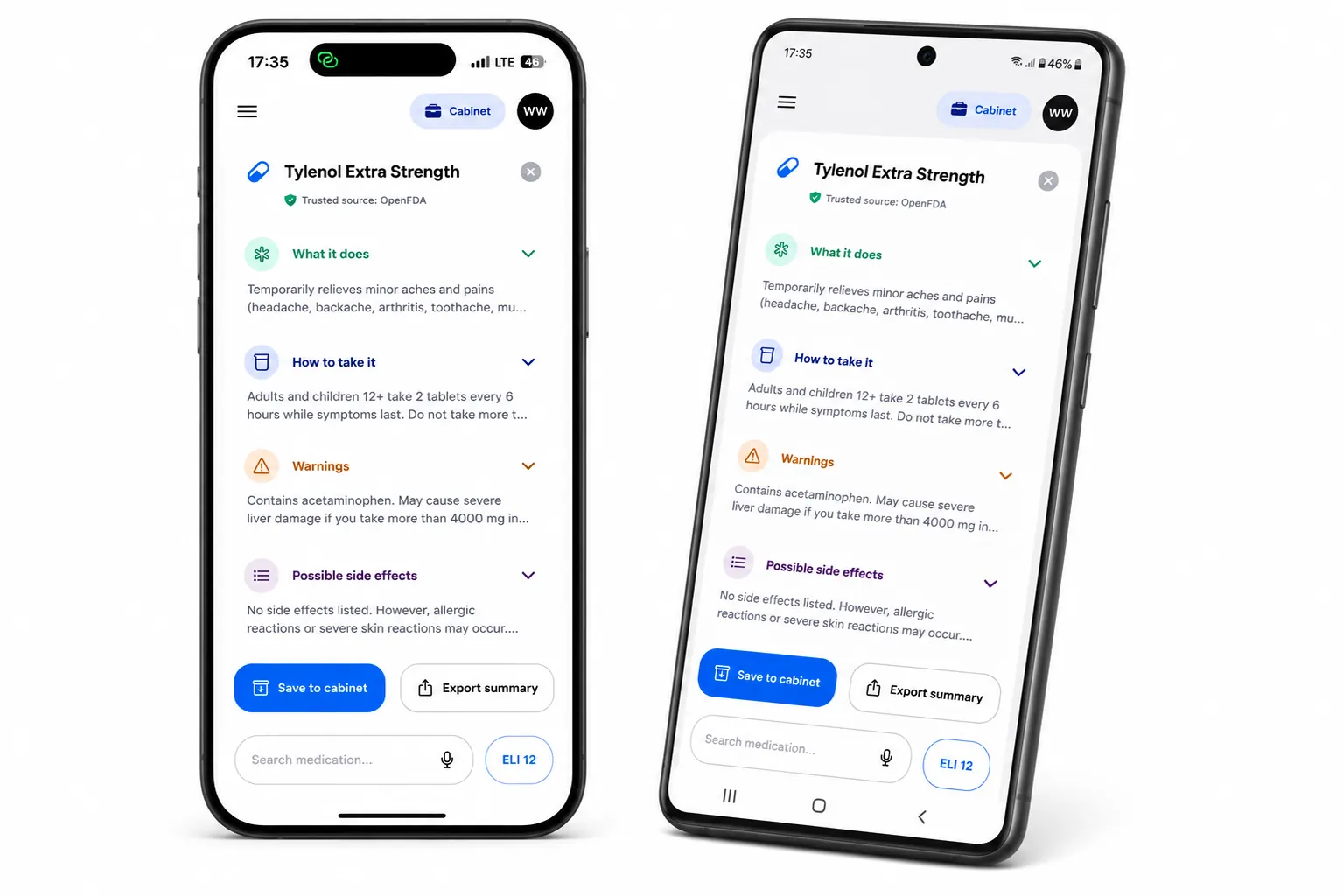
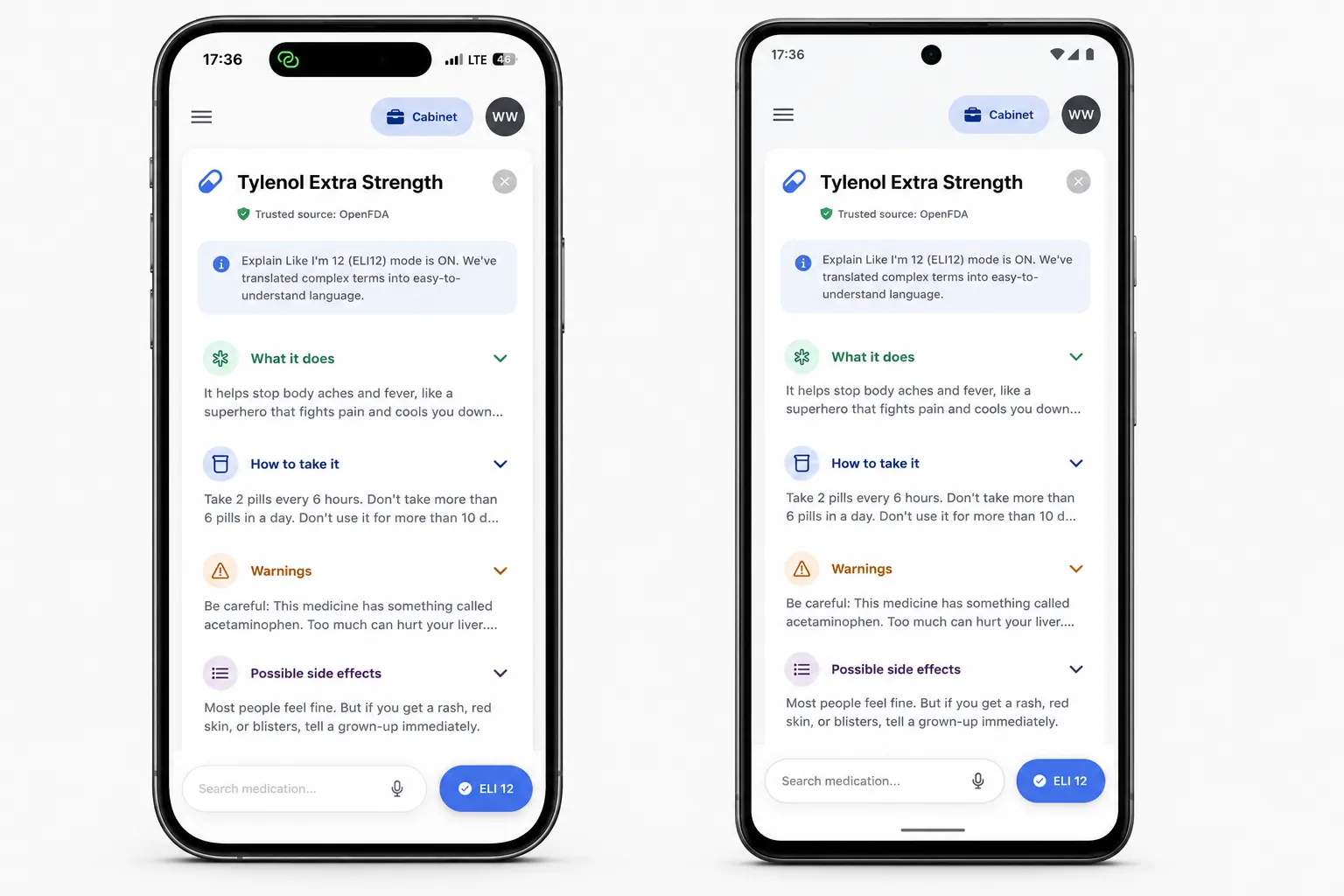
ELI12 (Explain Like I'm 12)
For maximum accessibility, users can toggle a mode that further simplifies explanations into language an average twelve-year-old could understand.
- Maximum accessibility
- Zero jargon
- Toggleable mode
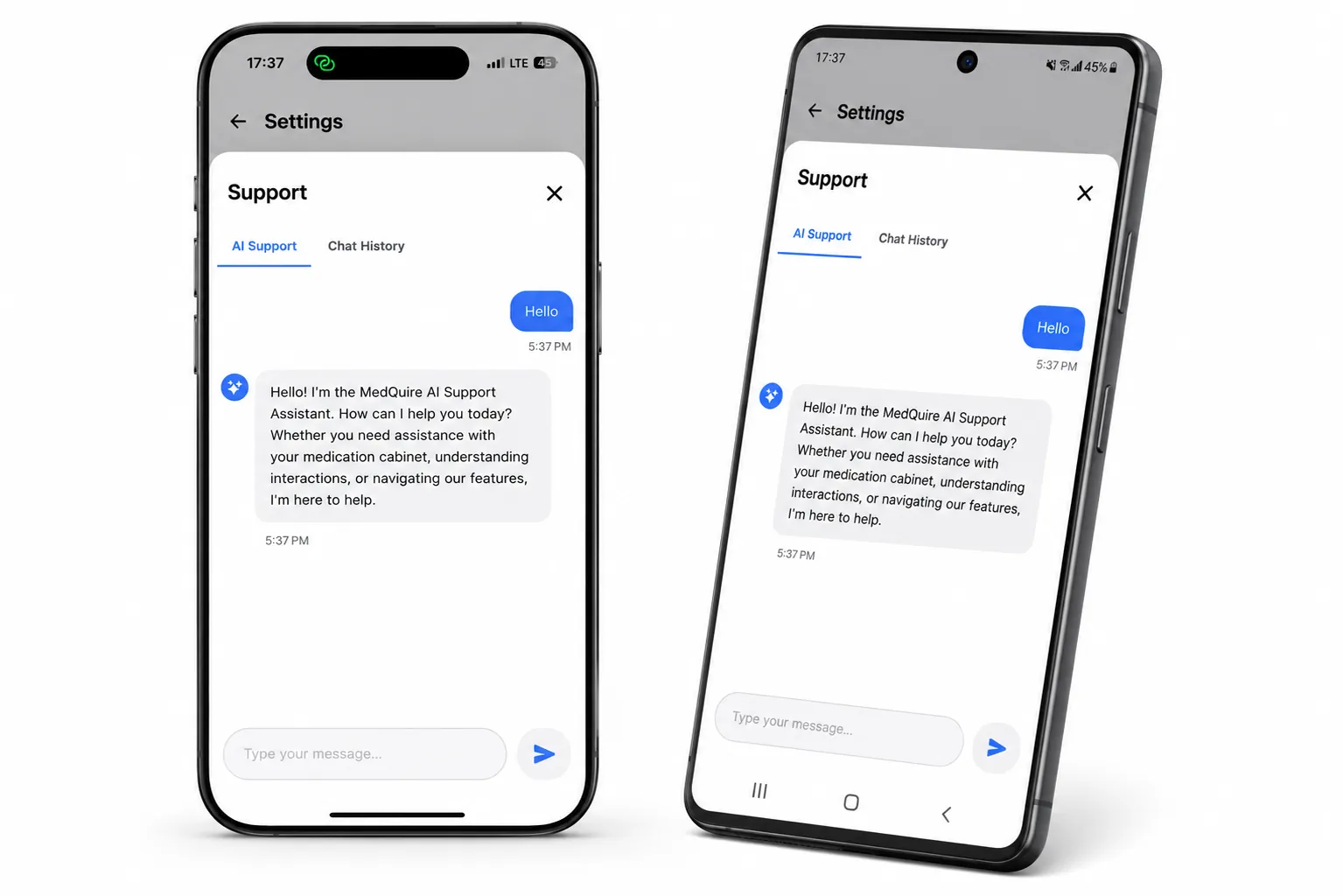
AI Medication Assistant
A conversational interface allowing users to ask follow-up questions naturally, without performing multiple disjointed searches.
- Natural conversation
- Context aware
- Instant answers
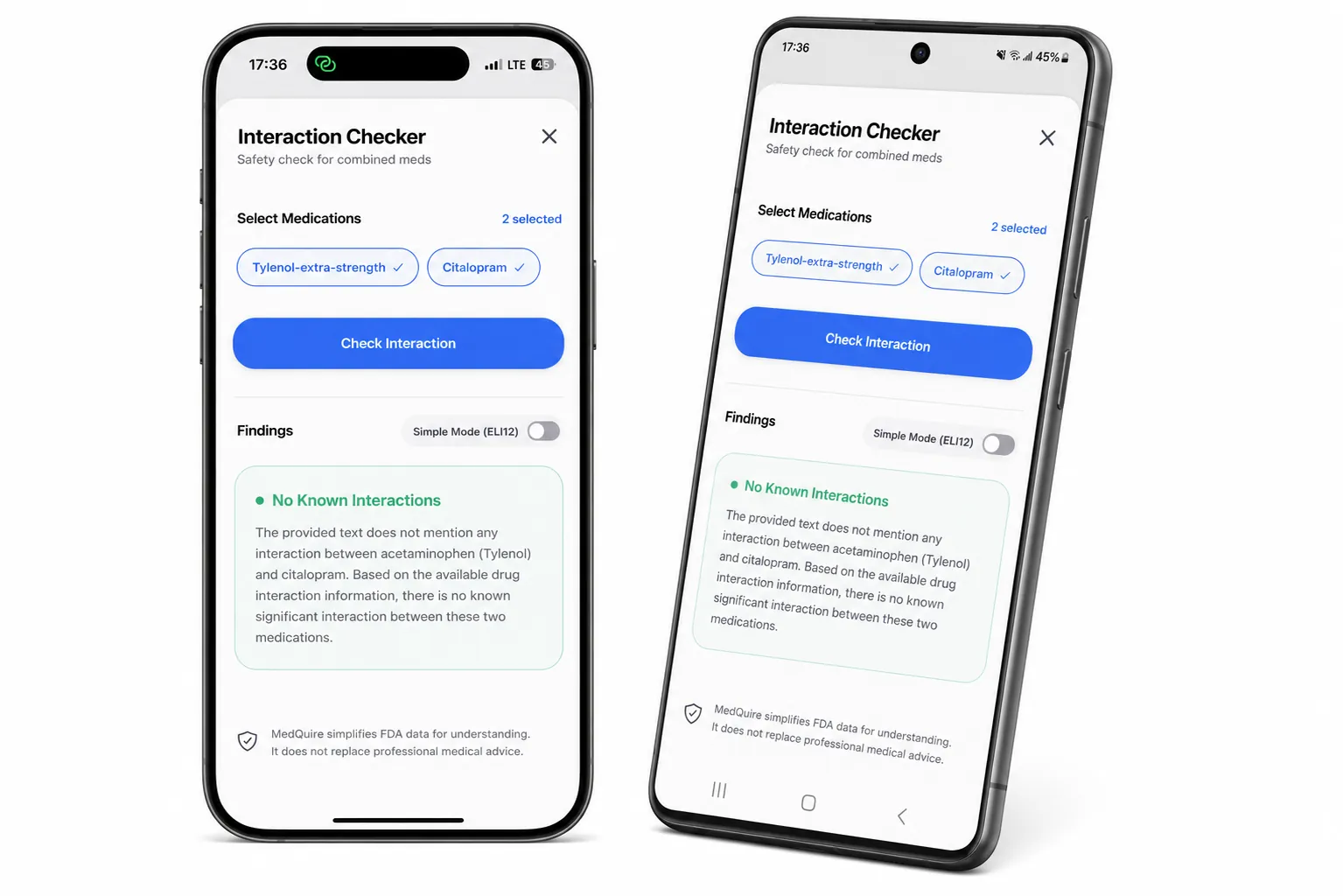
Drug Interaction Checker
Enables users to compare multiple medications and receive easy-to-understand explanations of potential interactions.
- Multi-drug comparison
- Simplified risk levels
- Actionable advice
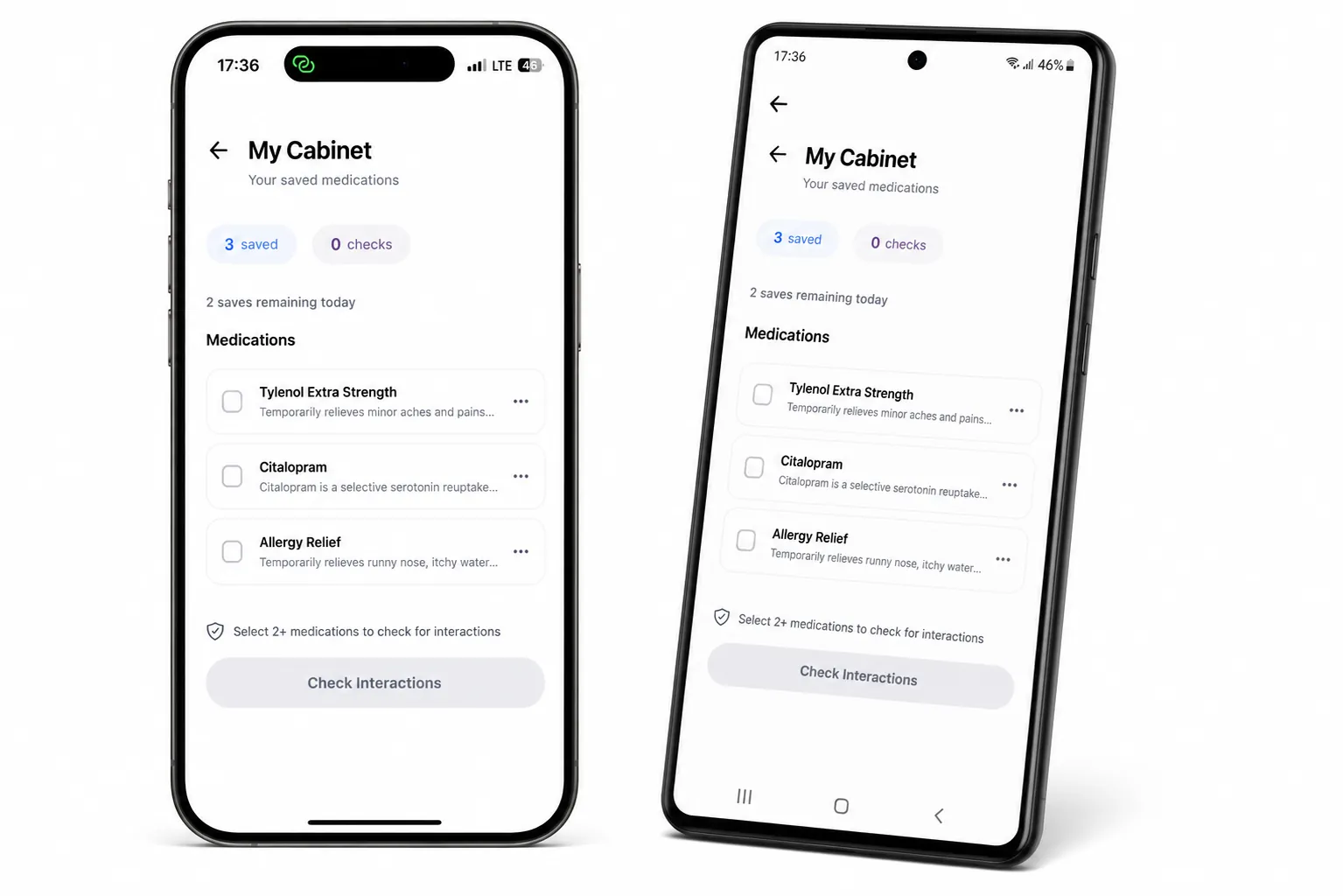
Personal Medicine Cabinet
A dedicated space where users can save frequently used medications for quick future reference.
- Quick reference
- Saved history
- Easy access
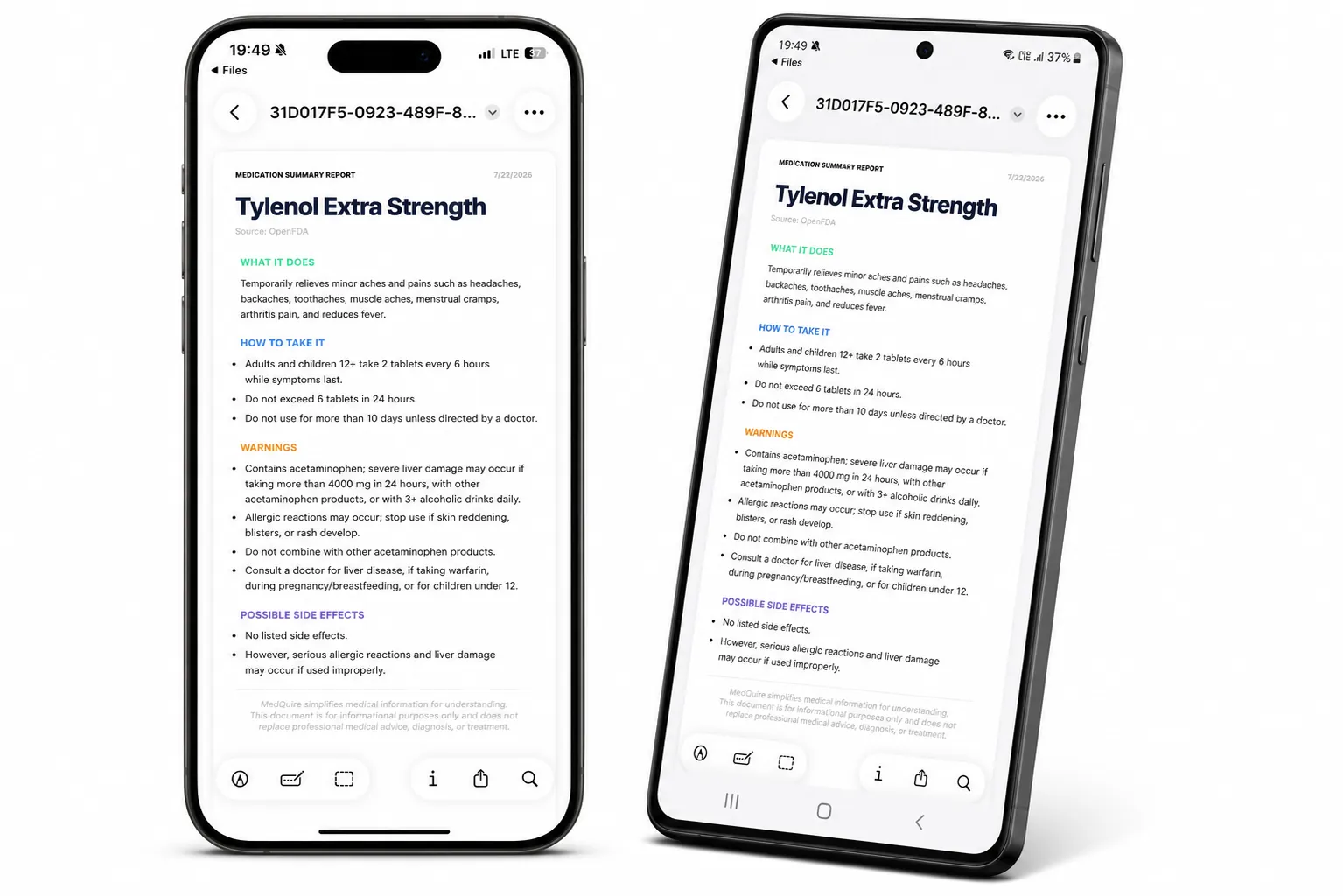
Exportable Medication Summary
Generates simplified summaries that users can easily share with family members or caregivers.
- Printable format
- Caregiver ready
- Shareable link
Design Experience
Because MedQuire targets a broad audience with varying levels of digital literacy, our design process prioritized reducing cognitive effort over everything else.
Design Principle
"Every interface decision was measured against one question: Does this make medication information easier to understand?"
Information Architecture & User Journey
Discover
Searching for a medication.
Understand
Reading the simplified explanation.
Explore
Asking follow-up questions.
Personalize
Saving to Medicine Cabinet.
Core UX Decisions
Progressive Disclosure
Only reveal advanced actions when users actually need them.
Accessible Language
Medical terminology is rewritten into plain language everyone can understand.
Reduced Cognitive Load
Information is grouped into clear sections with strong visual hierarchy.
Empathy Map, Persona & Pain Points
While MedQuire was developed collaboratively by our team, I personally led the user research, mapped out user pain points, and created the empathy map & user persona to anchor our design decisions.
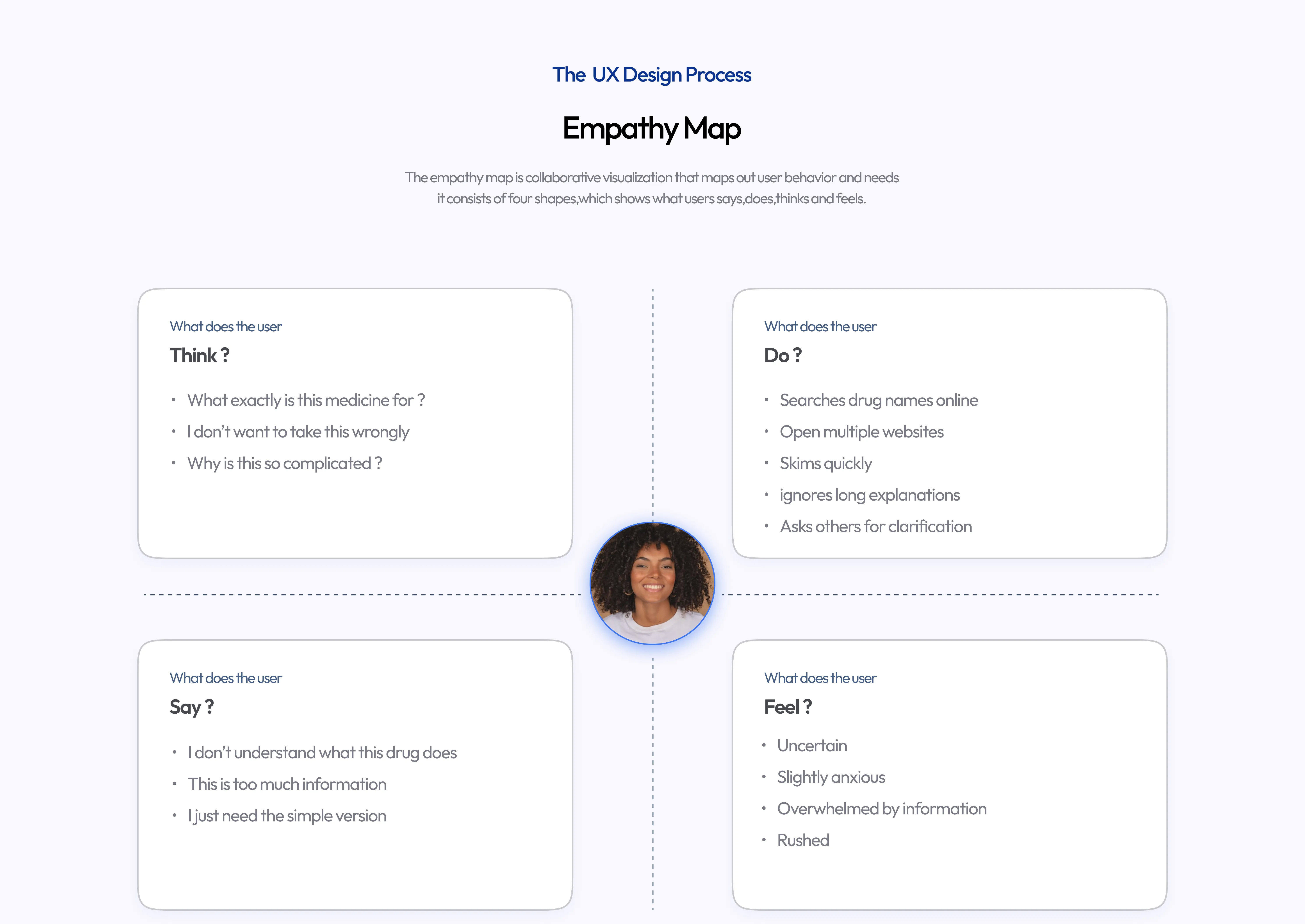
Empathy Map
Synthesizing user interviews and observations to deeply understand the emotional and practical hurdles patients face when managing unfamiliar prescriptions. This informed our clear, empathetic design direction.
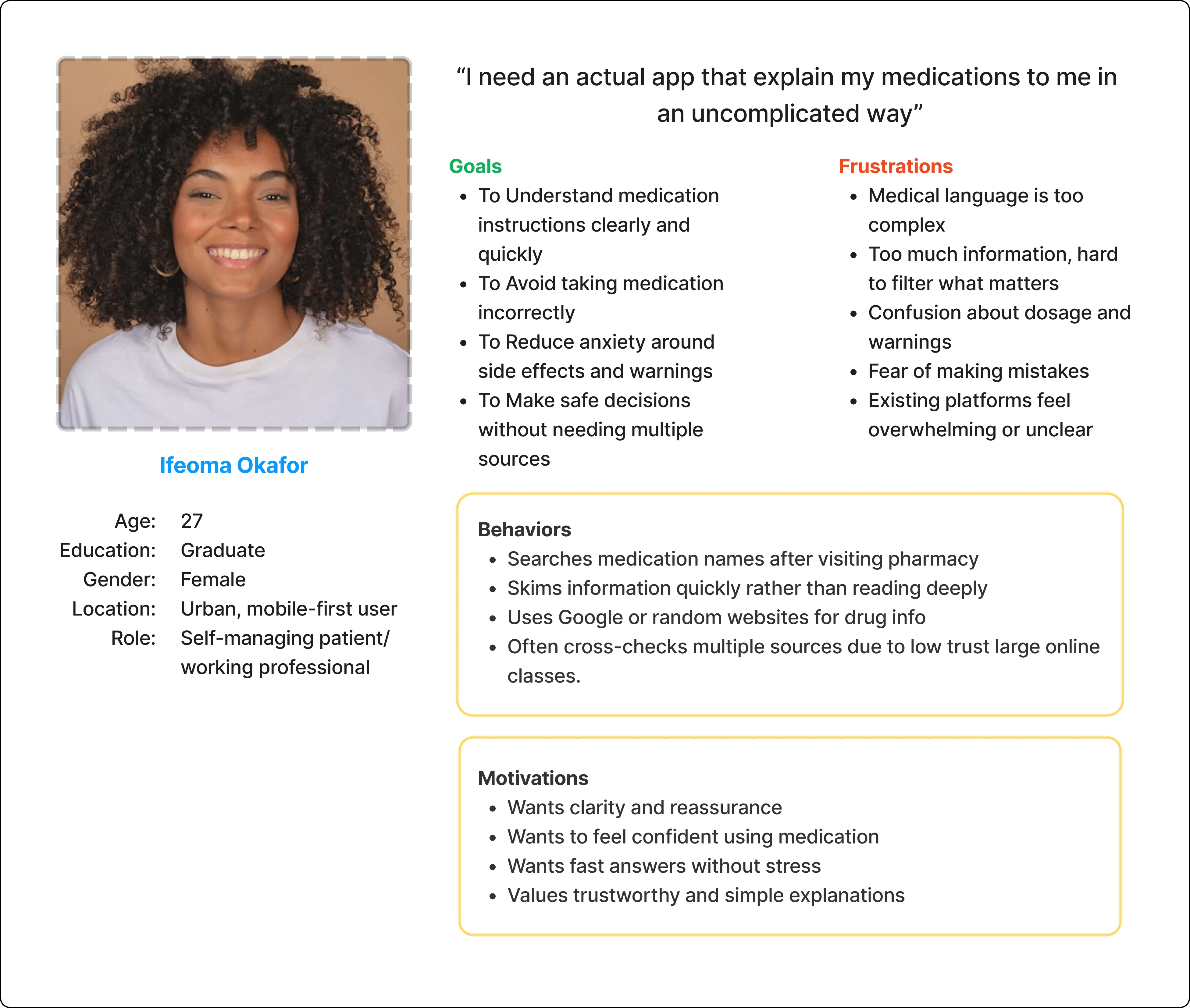
User Persona
A detailed representation of our primary user persona, guiding product decisions to ensure the interface accommodates non-technical users and individuals with diverse accessibility needs.
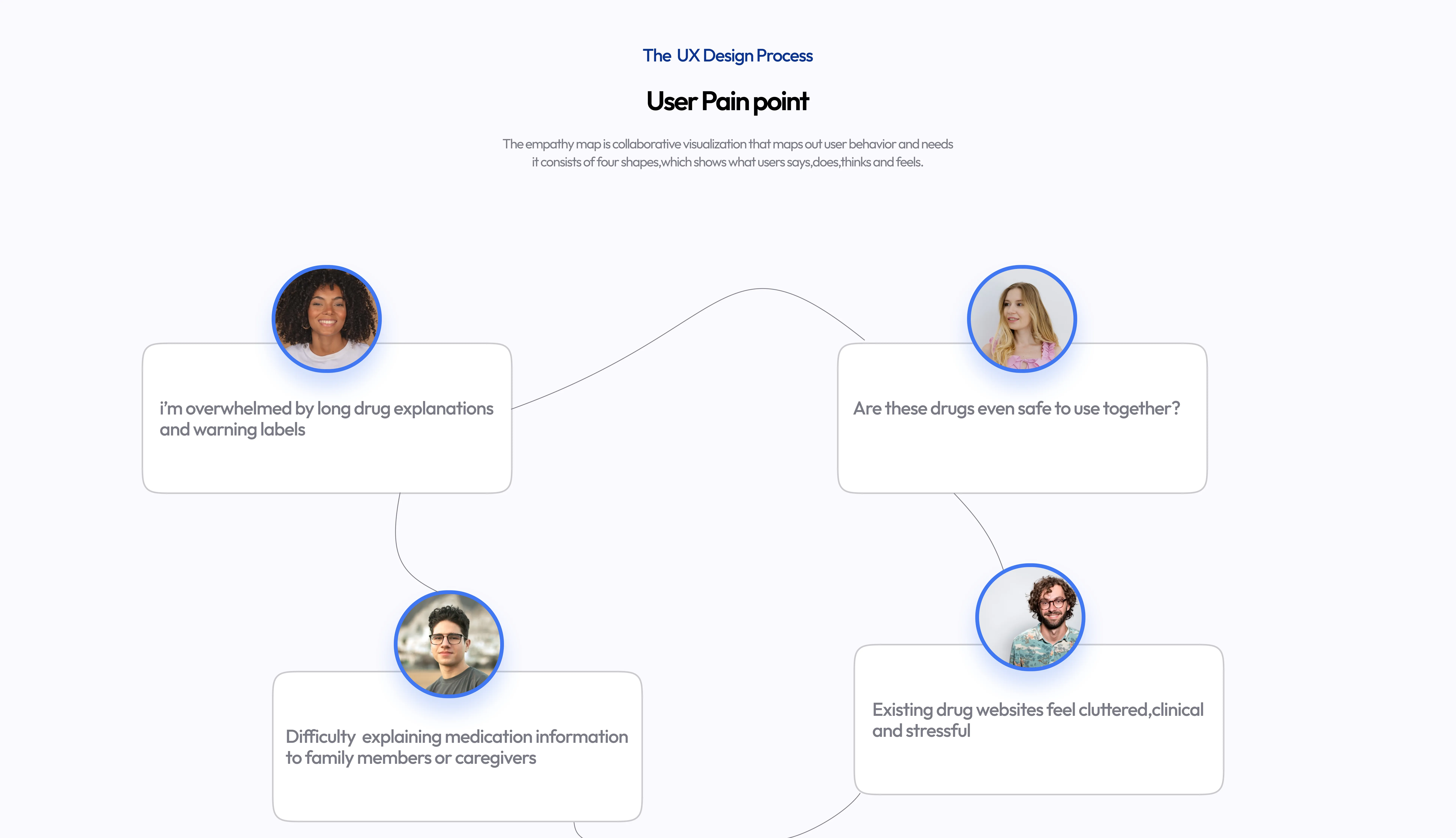
User Pain Points
Mapping the exact moments where communication breaks down in the traditional prescription journey to identify high-impact opportunities for AI assistance.
Design Process
We followed a user-centered design process to uncover real communication barriers, validate assumptions, and iteratively design a product that makes medication information easier to understand.
Empathize
Conducted user interviews and competitive analysis to uncover medication literacy challenges.
Define
Mapped user pain points and defined the core problem: information exists, but comprehension doesn't.
Ideate
Explored AI-powered concepts like ELI12 and conversational assistance to simplify medication understanding.
Prototype
Designed low-fidelity wireframes focused on progressive disclosure and intuitive information architecture.
Test
Validated usability through feedback, ensuring users could confidently search, understand, and interact.
Empathize
Conducted user interviews and competitive analysis to uncover medication literacy challenges.
Define
Mapped user pain points and defined the core problem: information exists, but comprehension doesn't.
Ideate
Explored AI-powered concepts like ELI12 and conversational assistance to simplify medication understanding.
Prototype
Designed low-fidelity wireframes focused on progressive disclosure and intuitive information architecture.
Test
Validated usability through feedback, ensuring users could confidently search, understand, and interact.
"Every design decision was evaluated against one guiding question: Does this make medication information easier to understand?"
Core User Flows
While the Primary User Journey illustrates the overall MedQuire experience, every major feature was mapped into its own interaction flow to remove friction and simplify user decisions.
Guiding Principle
Help users accomplish their goal with as few steps as possible while maintaining clarity throughout every interaction.
Guest User Flow
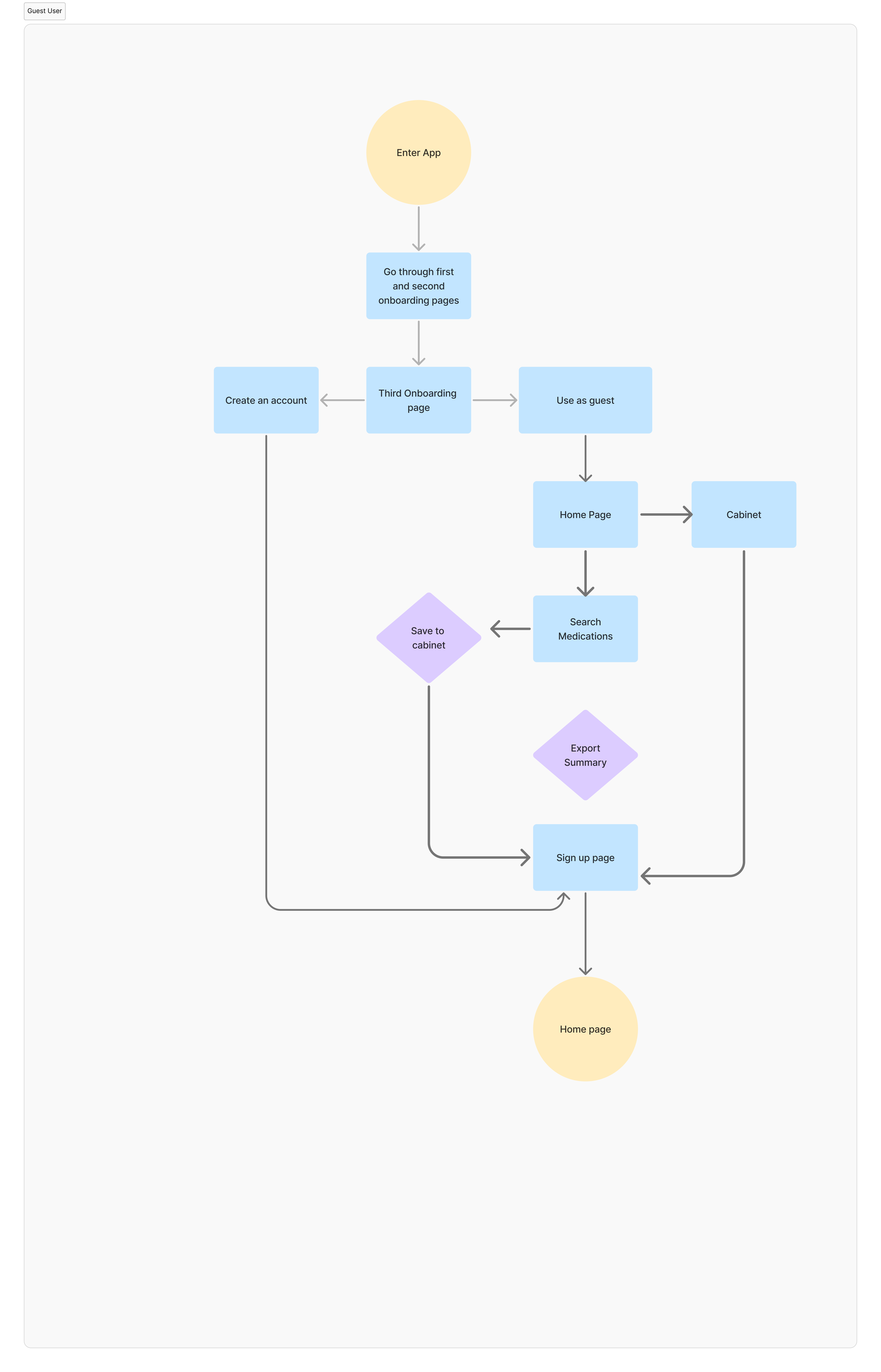
The user flow map was instrumental in defining a progressive disclosure navigation pattern, ensuring users complete their primary task (understanding medication) before being introduced to advanced features.
User Flow
Medication Search Flow
Searching for medication is the primary entry point into MedQuire. This flow illustrates the shortest path from opening the app to understanding a medication while minimizing friction and cognitive load.
Key UX Decision
We intentionally reduced the primary journey to only a few essential interactions, helping users reach understandable medication information with minimal effort while keeping advanced features optional.
User Flow
Drug Interaction Checker Flow
Understanding how medications interact is an important part of medication safety. The interaction checker was designed to make this process straightforward while presenting results in language that users could easily understand.
Design Considerations
- Keep the process simple.
- Present interaction results without unnecessary medical jargon.
- Prioritise explanation over technical terminology.
User Flow
Personal Medicine Cabinet Flow
Many users regularly search for the same medications. The Personal Medicine Cabinet allows them to build their own medication library for quick future access.
Design Considerations
- Reduce repeated searches.
- Support long-term engagement.
- Make frequently used medications easy to revisit.
Design System
"MedQuire's design system established a consistent visual language that made complex healthcare information easier to understand while ensuring every screen felt familiar, accessible, and trustworthy."

Color System
Emerald green reinforces health, clarity, and trust throughout the experience.
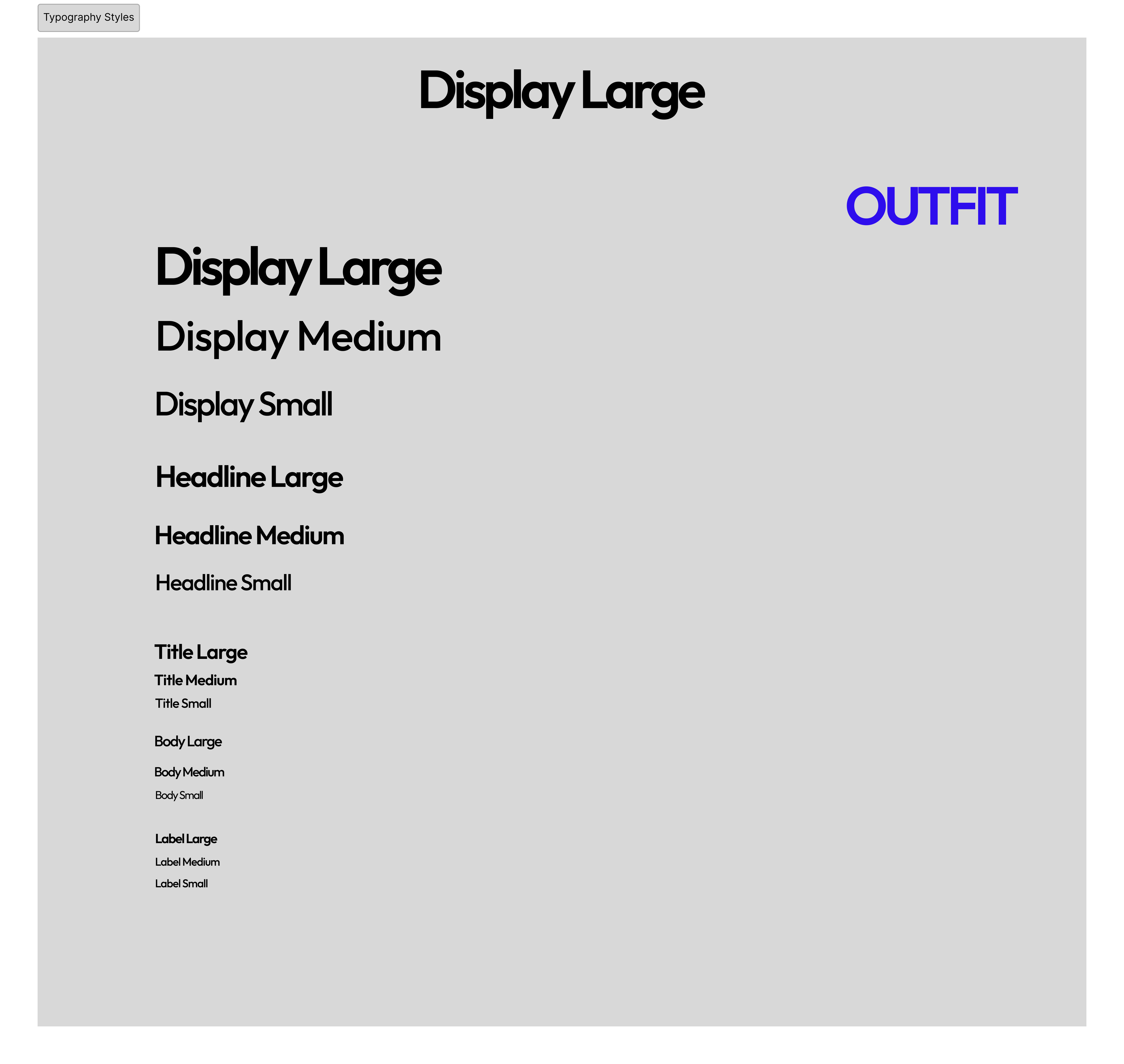
Aa Typography
Readable type scales improve comprehension across all ages.
Core Principles
Clarity
Medical information should be understandable at first glance.
Consistency
Reusable patterns reduce cognitive effort.
Accessibility
Readable typography, spacing and touch targets improve usability.
Trust
Professional visual design builds confidence in healthcare decisions.
Visual Language
A carefully curated set of visual decisions designed to reduce anxiety and make complex health information feel approachable.
From Design to Development
The same design system guided both product design and engineering, ensuring consistent implementation across React Native screens while reducing design debt and improving scalability.
Engineering & Architecture
MedQuire was built with a modern, scalable technology stack designed to support seamless AI interactions on mobile devices.
React Native + Expo
Cross-platform mobile application built with TypeScript.
Railway
Hosts backend services and API endpoints that power MedQuire.
Supabase
Provides user authentication, PostgreSQL database and secure data management.
DeepSeek API
Processes medication information and generates simplified explanations.
OpenFDA API
Trusted regulatory medication database used for verified drug information.
React Context API
Manages global application state, asynchronous requests and loading states.
System Architecture
Engineering Challenges
Medical Accuracy
Simplifying medication information without losing essential medical warnings.
Prompt engineering, structured context management and validation logic ensured AI responses remained accurate while easy to understand.
Performance & Reliability
Coordinating multiple asynchronous services including Railway, Supabase, DeepSeek and OpenFDA without slowing down the user experience.
Implemented Context API, centralized loading states, caching and robust error handling to deliver smooth and responsive interactions.
Outcomes
MedQuire successfully bridged the communication gap between patients and providers, transforming technical medical data into accessible, everyday language.
Functional MVP
By the end of the project, our team successfully transformed an initial product idea into a functional AI-powered mobile application capable of helping users better understand medication information.
Real-World Impact
MedQuire evolved into a working MVP that demonstrates how artificial intelligence can be used to improve accessibility within healthcare while supporting, rather than replacing, professional medical guidance.
Cross-Disciplinary Collaboration
The project brought together product strategy, user experience design, mobile engineering, artificial intelligence, and collaborative problem-solving into a single product experience.
Working MVP
AI-powered medication companion
Cross Platform
Built for Android & iOS
AI Assisted
DeepSeek + OpenFDA integration
Built in 1 Month
Collaborative team delivery
Working MVP
AI-powered medication companion
Cross Platform
Built for Android & iOS
AI Assisted
DeepSeek + OpenFDA integration
Built in 1 Month
Collaborative team delivery
Key Takeaway
MedQuire demonstrated how thoughtful product design, AI and modern engineering can work together to make complex healthcare information more understandable and accessible.
What We Delivered
Seven carefully selected capabilities designed to simplify medication understanding.
AI Medication Explanation
Explain prescriptions in simple everyday language.
ELI12 Mode
Break down complex medical terms into explanations anyone can understand.
AI Medication Assistant
Allow users to ask follow-up questions through conversational AI.
Drug Interaction Checker
Identify possible medication interactions before use.
Personal Medicine Cabinet
Save and organize frequently used medications for quick access.
Export Summary
Generate simplified medication summaries that can be shared with caregivers or family.
Secure Authentication
Personalized and secure user accounts powered by Supabase authentication.
Why these features?
Every feature was intentionally designed to reduce confusion, improve accessibility and help users make more informed decisions about their medications.
UI Screens
Beyond the core medication experience, MedQuire includes thoughtfully designed interfaces that support onboarding, personalization, accessibility, and everyday medication management.
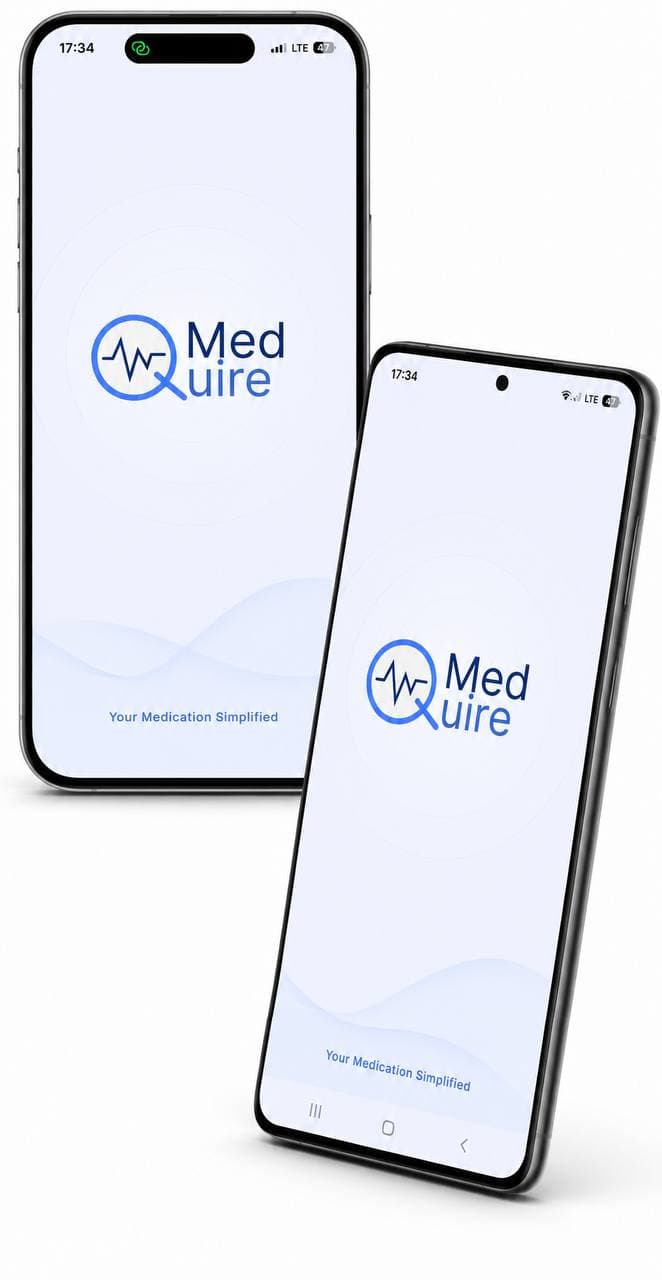
Splash Screen
A welcoming entrance that introduces the core mission of MedQuire.
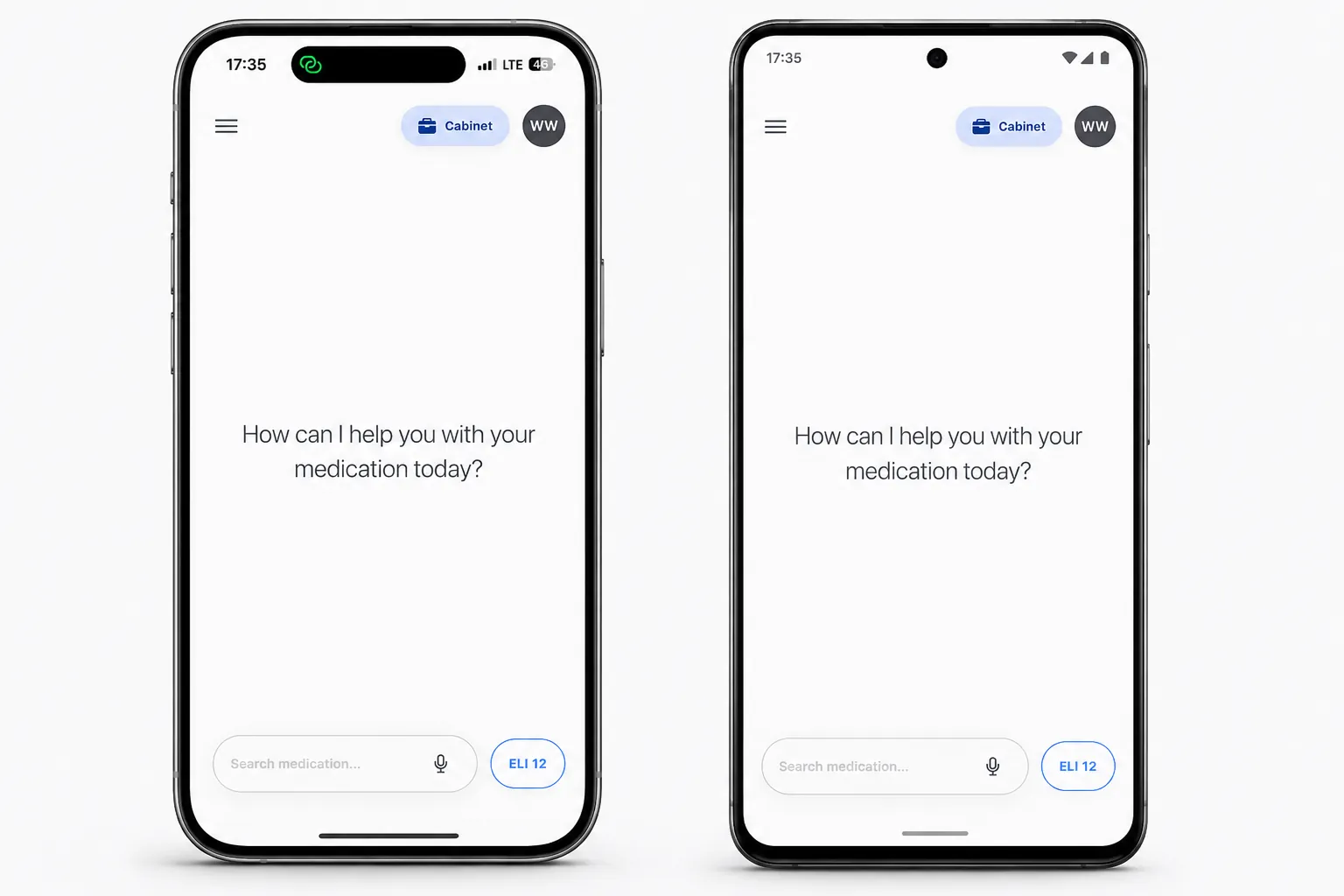
Home Dashboard
Your personalized dashboard for tracking and managing your medications.
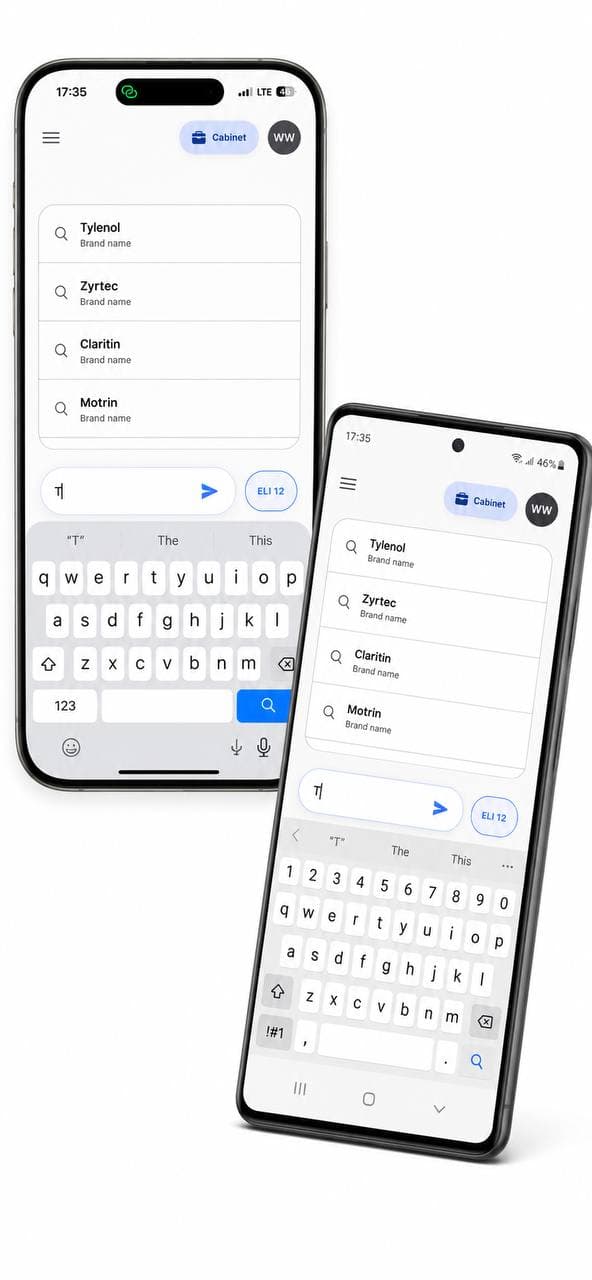
Search Auto-Complete
Instantly find medications with intelligent search suggestions as you type.
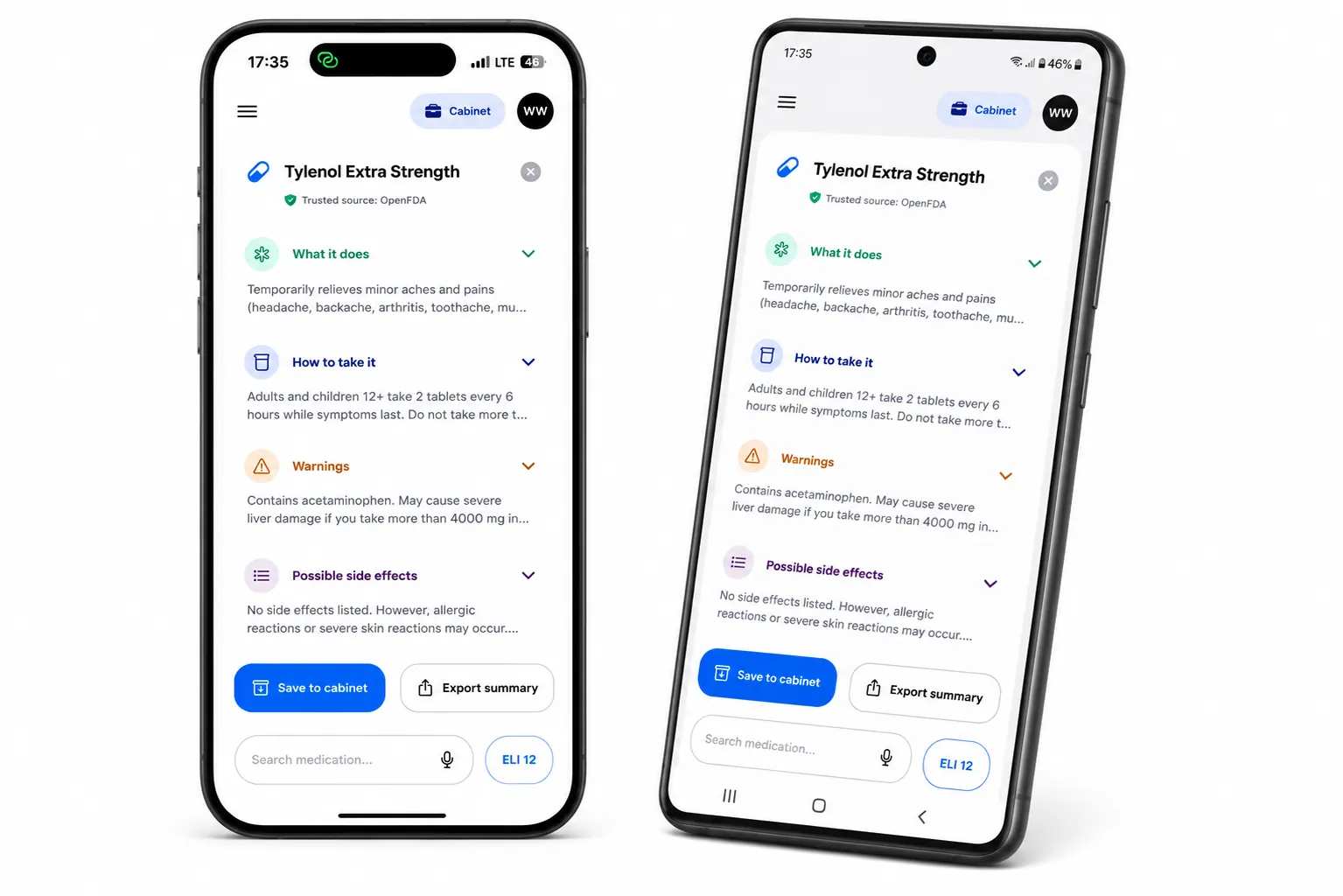
Search Results
Quickly receive trusted information from verified medical sources.
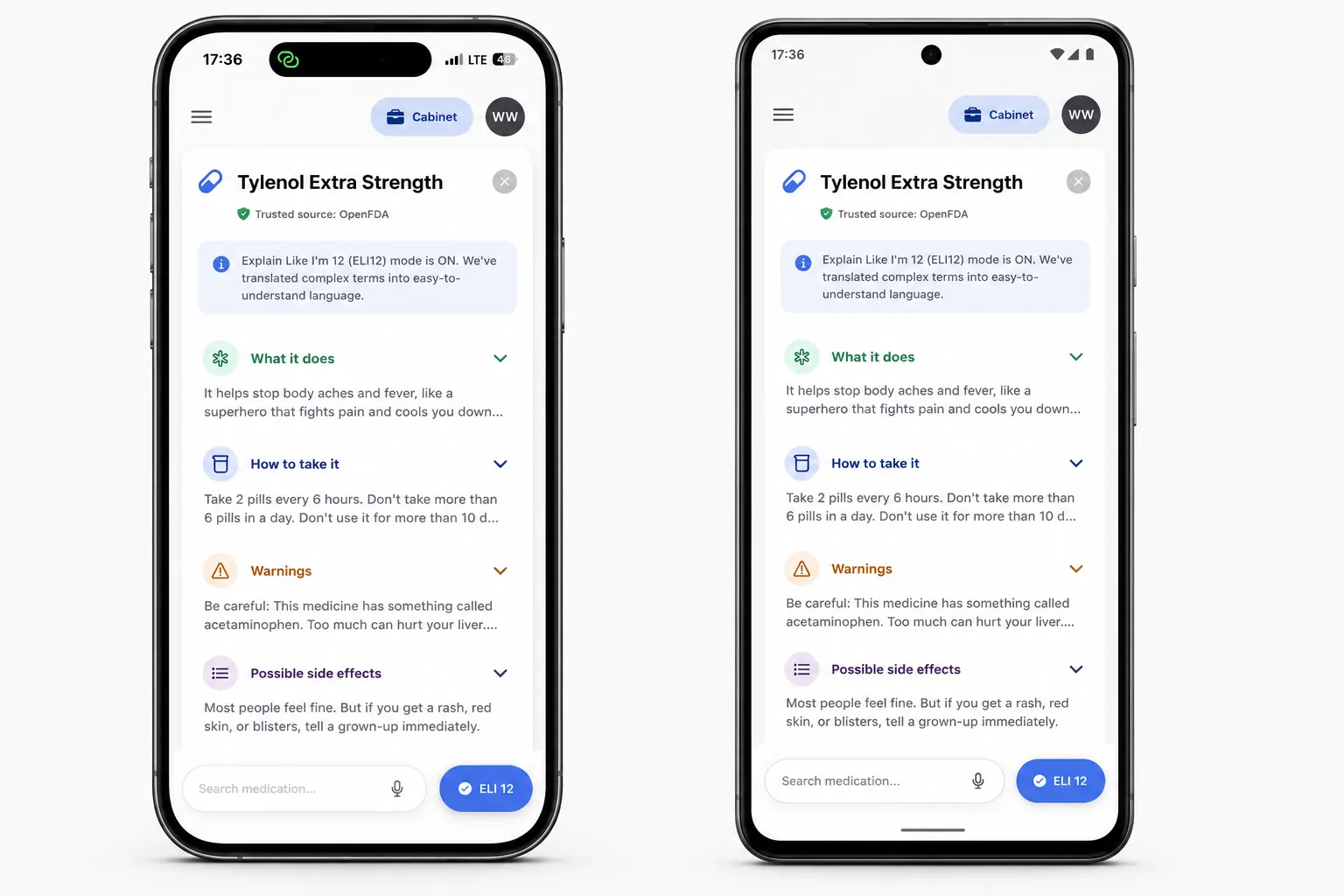
ELI12 Mode
Break down complex medical terms into explanations anyone can understand.
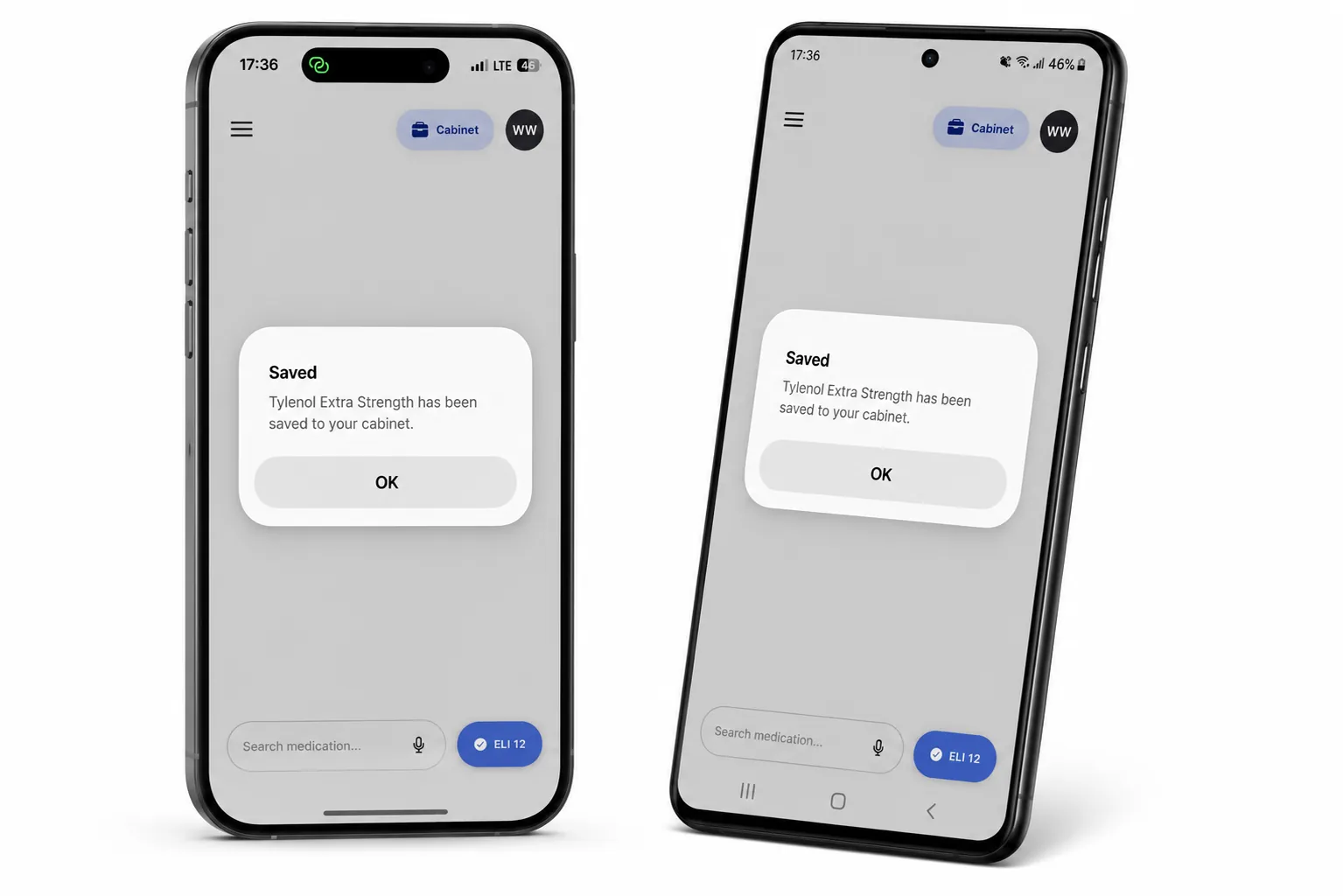
Save Medication
Easily add new medications to your personal cabinet with a single tap.
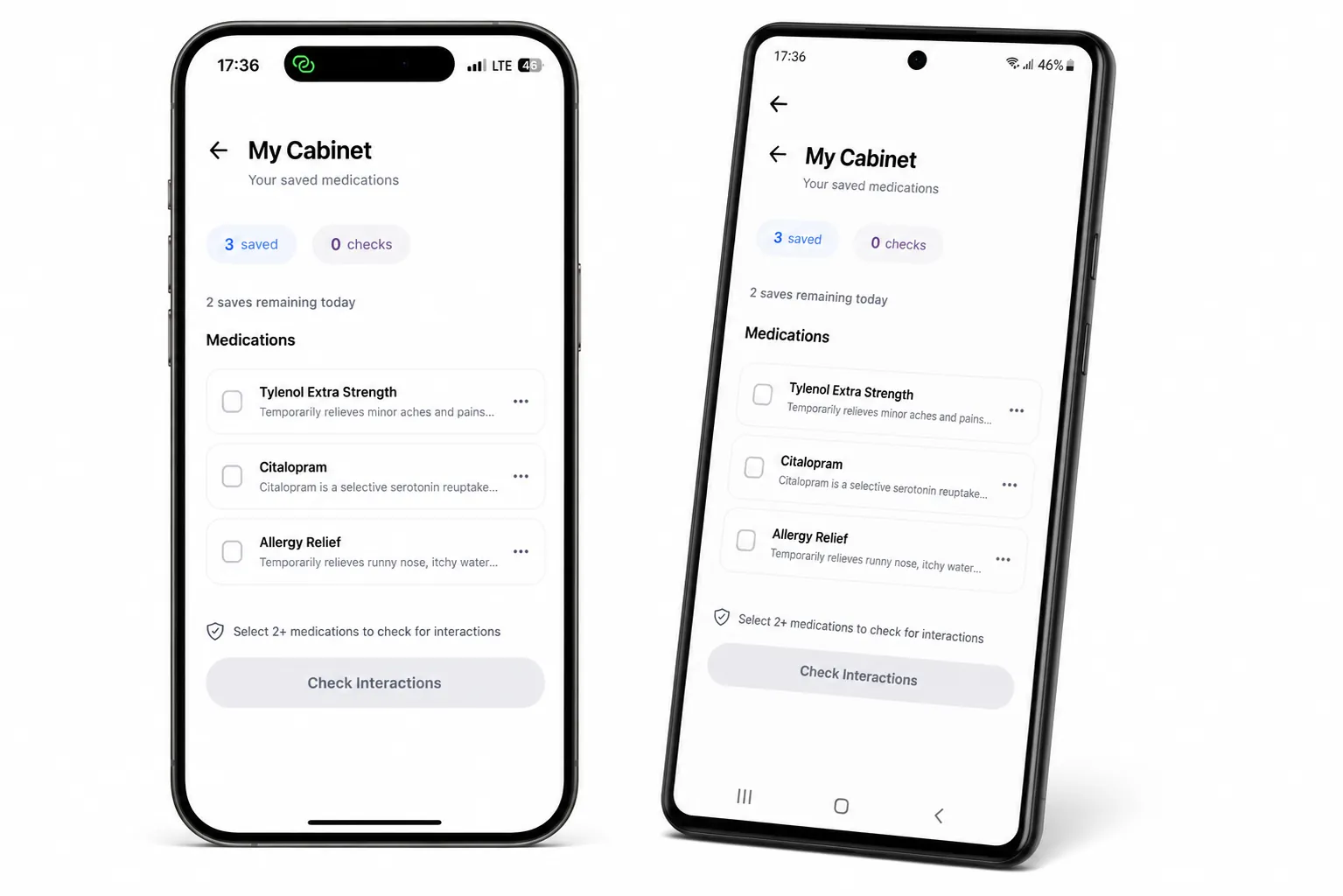
Medicine Cabinet
Revisit your frequently used medications without having to search for them again.
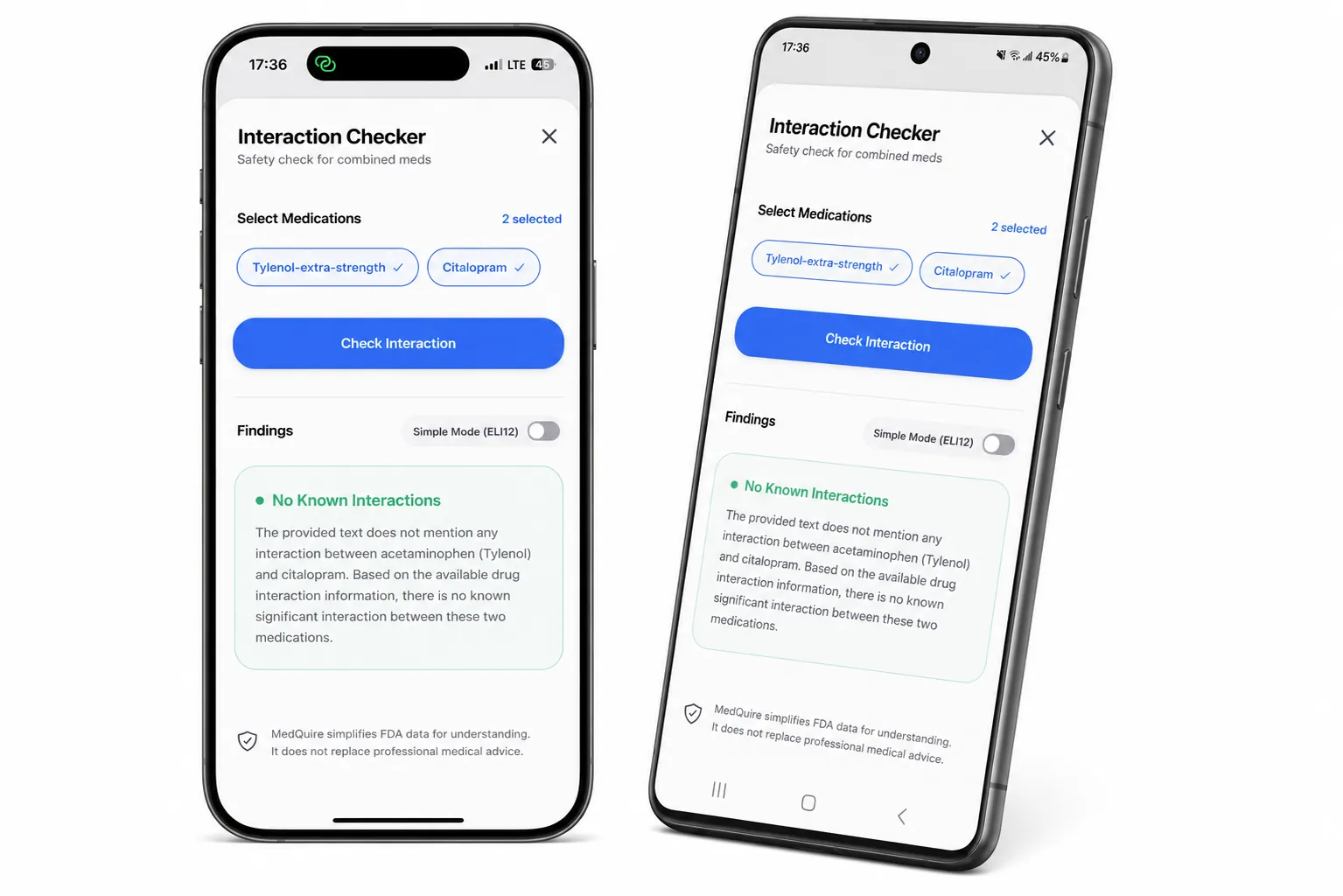
Drug Interaction Checker
Check whether two medications may interact before taking them together.
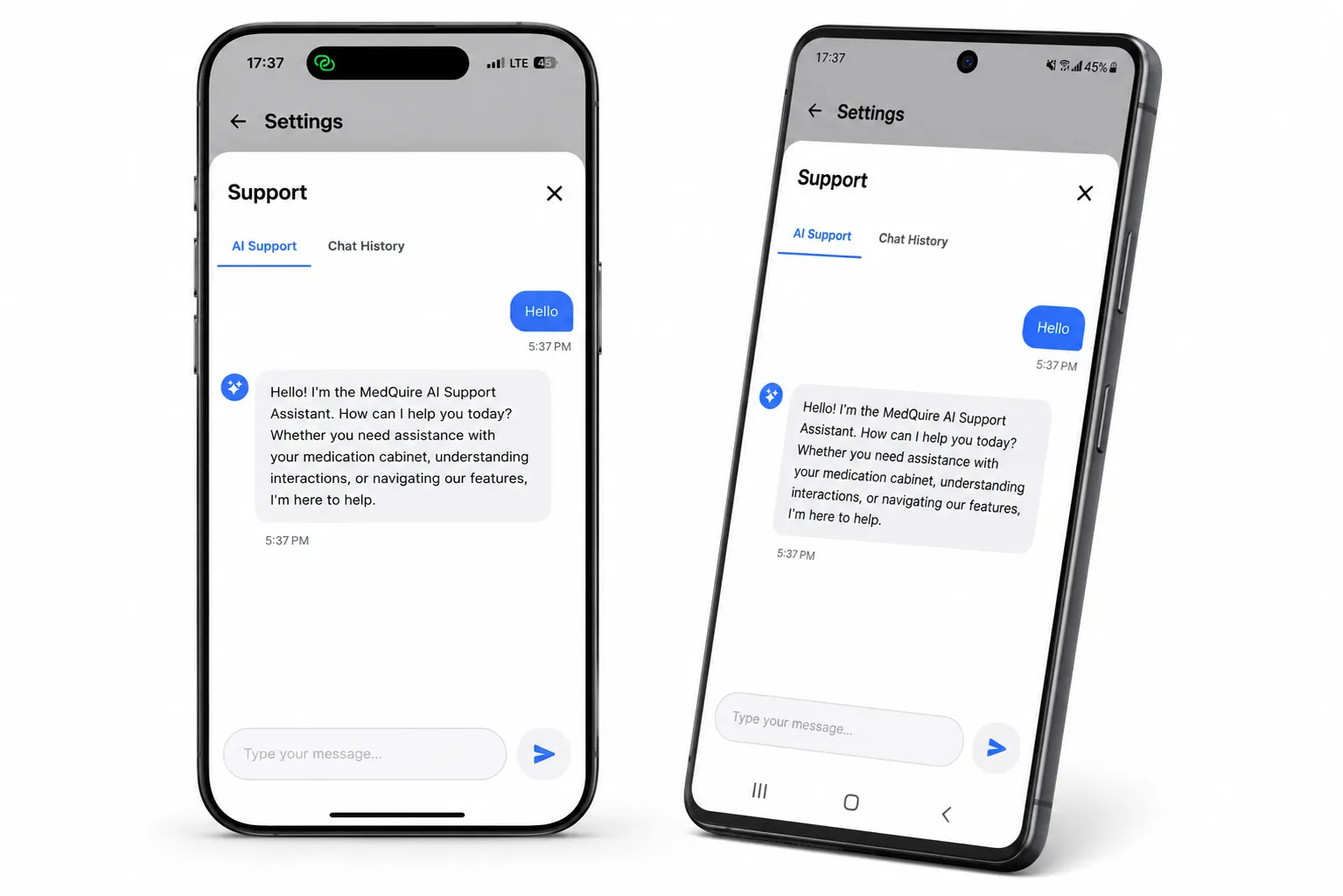
AI Conversation
Continue asking follow-up questions after reading a medication explanation.
A Collaborative Achievement
Building MedQuire was a shared effort that combined expertise across product design, mobile engineering, and AI integration.
Cross-functional Collaboration
Designers and engineers worked hand-in-hand throughout the entire product lifecycle. By removing silos, we fostered a unified environment where every team member understood the shared vision and actively contributed to building a functional, user-centric application.
Shared Product Decisions
We maintained a constant balancing act between multiple priorities, ensuring our decisions aligned with our overarching objectives:
- User needs
- Technical feasibility
- Product goals
- Engineering constraints
Continuous Iteration
Close collaboration enabled extremely rapid feedback loops. We were able to iterate continuously on both designs and code, refining the application in real-time until the MVP achieved exactly what we set out to build.
Product Design
Research, UX and interface design.
Engineering
React Native architecture and implementation.
Collaboration
Cross-functional teamwork throughout development.
Shared Goal
Deliver an AI-powered healthcare experience.
"Great products are rarely built by one discipline alone—they emerge through continuous collaboration between design, engineering, and product thinking."
Product Design +
Product Engineering
I contributed across product design and engineering, helping shape both the user experience and the application's technical foundation.
Product Design
Participated in product direction, user experience discussions, interface design, and feature planning.
React Native
Scaffolded the React Native application and established the project structure.
Context Architecture
Designed and implemented the Context API architecture for scalable shared state management.
Cross-functional Collaboration
Worked closely with the team across design and engineering to translate ideas into a working product.
Product Thinking
Contributing to the engineering side of the project profoundly changed the way I think about product design. Participating in early product discussions, user experience planning, and interface design gave me a deep appreciation for solving the right problem before writing any code.
Our research made it clear that the challenge wasn't a lack of medication information, but rather making existing information easier for everyday people to understand. This insight guided my technical approach, ensuring our solutions were both user-centred and technically practical.
Engineering Contribution
Beyond design, I was fully responsible for scaffolding the React Native application from the ground up and implementing the Context API architecture that powered our scalable shared state management.
While the backend infrastructure relied on powerful external services—including Railway for application hosting, Supabase Authentication for secure onboarding, and Supabase Database for persistent storage—my core engineering focus remained on crafting a robust, responsive frontend architecture that seamlessly integrated these services.
What I Learned
Working across both design and engineering significantly strengthened my understanding of how to build AI-powered products. I learned firsthand that building meaningful products requires much more than creating polished interfaces—it demands understanding people, making thoughtful trade-offs, and continuously refining solutions based on both user needs and technical constraints.
Reflection
MedQuire challenged me to think beyond interface design and embrace modern AI-assisted development workflows. By combining strategy, UX, engineering, and artificial intelligence, I've developed a much more holistic approach to product development. Rather than viewing design and engineering as separate disciplines, I now see them as complementary parts of a single, unified creative process.
"Working on MedQuire reinforced that great products emerge when thoughtful design and solid engineering evolve together."
Future Roadmap
Although MedQuire successfully validates the core concept of improving medication understanding through artificial intelligence, the current MVP represents only the beginning of the product's long-term vision.
Throughout the project, we uncovered several high-impact opportunities that could further enhance the experience while remaining closely aligned with our mission of bridging the communication gap between patients and healthcare providers.
OCR Prescription Scanner
Extract medication information directly from prescription labels.
Barcode Scanner
Instantly identify medications by scanning packaging.
Medication Reminders
Help users stay consistent with scheduled medications.
Offline Mode
Access previously viewed medication information without an internet connection.
Multi-language Support
Translate medication guidance into multiple languages.
Regional Database
Expand beyond OpenFDA by integrating additional medication databases for broader regional coverage.
Family & Caregiver Sharing
Allow users to securely share medication summaries with caregivers and family members.
Personalized AI
Provide explanations tailored to user history, health literacy, and preferences.
Enhanced Accessibility
Improve usability through voice support, larger touch targets, and accessibility enhancements.
Long-term Vision
MedQuire's roadmap is centered on making medication information more accessible, personalized, and globally available while maintaining simplicity and trust.
Closing Thoughts
MedQuire began with a simple but powerful vision: to help people better understand their medications and bridge the communication gap between patients and providers.
What started as an idea evolved into a fully functional AI-powered healthcare product. Guiding this project from concept to implementation profoundly strengthened my ability to unite product strategy, empathetic UX design, and robust engineering architecture into a cohesive, meaningful experience.
The Journey
Transforming MedQuire from a conceptual idea into a working MVP required continuous iteration. We navigated early user research, rapid prototyping, architecture planning, and rigorous testing, ultimately proving that complex medical data could be made accessible through intelligent design and engineering.
What I Learned
Working holistically on this project deepened my understanding of how different disciplines interact. I learned to balance:
- Product Strategy
- UX Design
- Product Engineering
- AI-assisted Development
Looking Forward
The lessons from MedQuire will heavily influence my future work. I now approach product development not just as a designer or engineer, but as a holistic problem solver who leverages both strategy and technology to create genuinely useful solutions for real people.
Lessons Learned
Think Like a Product Owner
Balance user needs with business and technical constraints.
Design with Clarity
Complex systems become valuable when they're easy to understand.
Engineer for Scale
Strong architecture enables faster iteration and maintainability.
Collaborate Continuously
The best products emerge from close collaboration between design and engineering.
"Technology creates the greatest impact when it transforms complexity into clarity."
Thanks for reading.
Thank you for taking the time to explore the MedQuire case study. If you'd like to discuss my design process, engineering approach, or future opportunities, I'd love to connect.