Contents
PlateUp
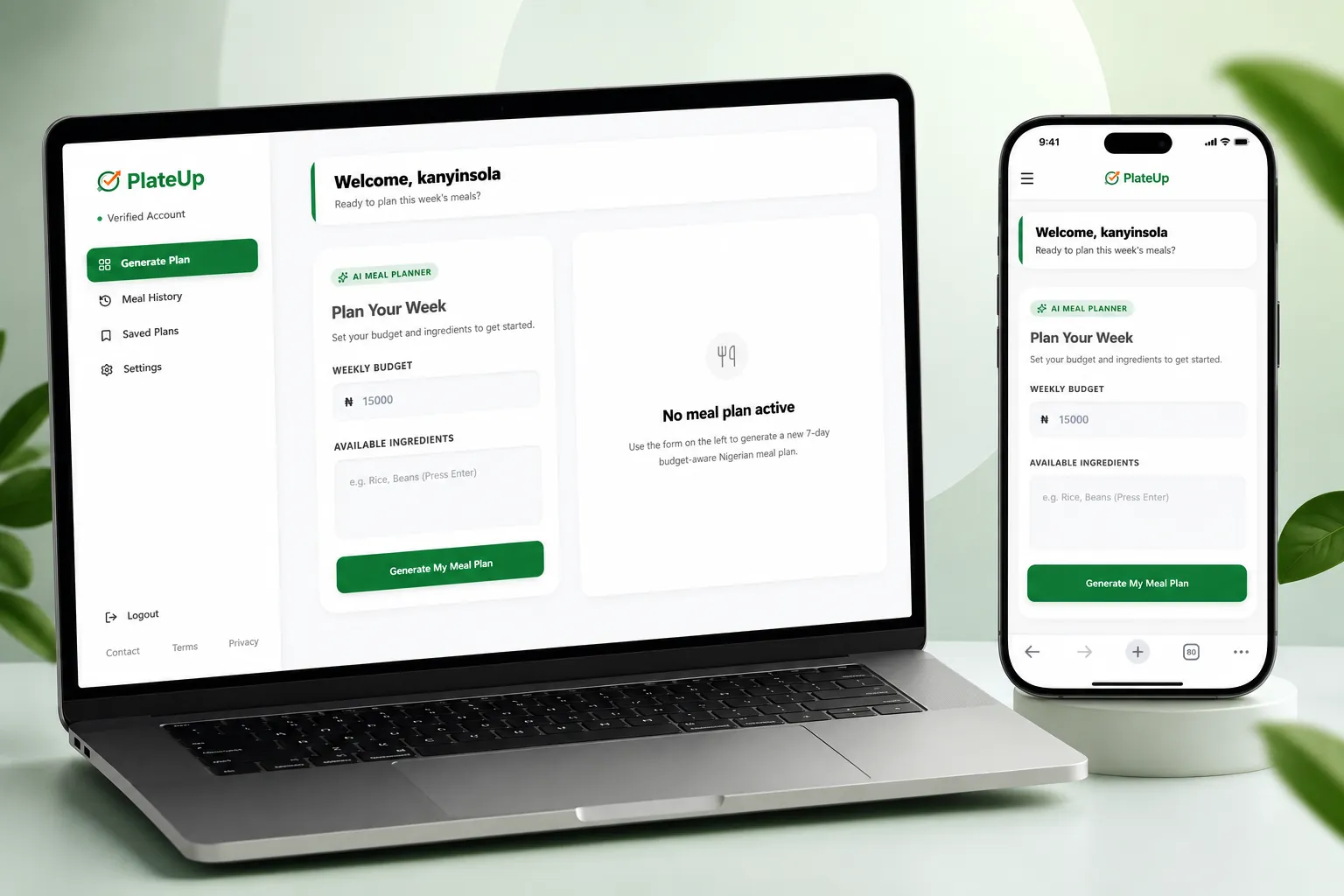
An AI-powered meal planning platform that helps Nigerian households generate personalized weekly meal plans and shopping lists based on their budget, pantry ingredients, household size, meal frequency, and personal goals.
Role
Product Designer & Product Engineer
Timeline
4–6 Weeks
Team
Solo Project
Platform
Responsive Web Application
Responsibilities
Every week begins with the same questions.
What are we cooking today?
Can we afford it?
Do we already have these ingredients?
Will this budget last the week?
Meal planning becomes a repetitive mental task for many Nigerian households. Without a structured planning system, families often overspend, waste food, repeat meals, and spend unnecessary time deciding what to cook.
Why Solving This Mattered
Poor meal planning doesn't just waste time—it affects household budgets, nutrition, and everyday decision-making.

Grocery Spending
Food is one of the largest recurring household expenses. Poor planning often leads to unnecessary grocery spending.

Food Waste
Without tracking what is already in the pantry, ingredients are forgotten and food waste increases.

Decision Fatigue
Repeatedly deciding what to cook every day creates mental fatigue and often leads to unnecessary market trips.
Project Goals
Every product decision in PlateUp was guided by five core objectives. Together, these objectives shaped how the AI plans meals for Nigerian households.
Who We Designed For
PlateUp was designed for people responsible for planning meals, managing grocery budgets, and reducing food waste in Nigerian households.
Primary Users
Nigerian Households
Planning meals for the entire family.
Parents
Managing weekly meals within a family budget.
Students
Preparing affordable meals on limited budgets.
Secondary Users
Young Professionals
Looking for convenient weekly planning.
Health-conscious Individuals
Seeking balanced meal options.
Budget-conscious Individuals
Trying to maximize every grocery purchase.
Understanding the Problem Before Designing the Solution
Before designing PlateUp, I wanted to understand why meal planning remained frustrating for many Nigerian households despite the availability of recipe websites and meal planning apps. Rather than starting with interfaces, I focused on understanding users, their behaviours, constraints, and decision-making process.
Continuous Throughout Development
Competitor Analysis, Secondary Research, Feedback
Competitor Analysis
| Solution | Strength | Opportunity for PlateUp |
|---|---|---|
| Recipe Websites | Large recipe collections | AI-powered weekly planning |
| Meal Planning Apps | Scheduling & reminders | Nigerian-first experience |
| AI Recipe Generators | Fast recipe generation | Budget & pantry awareness |
| Notes & Spreadsheets | Flexible | Automated planning |
Recipe Websites
Meal Planning Apps
AI Recipe Generators
Notes & Spreadsheets
User Pain Points → Product Opportunities
Key User Insight
Most Nigerians don't even eat three times a day.
Instead of forcing users into a fixed three-meal schedule.
User Feedback That Changed the Product
""|
""|
""|
User Needs → Product Features
Research Outcomes
Research directly influenced several major product decisions:
Research transformed PlateUp into a personalized planning assistant built around how Nigerian households actually make food decisions.
Defining What to Build
Translating Insights into Product Strategy
Connecting core user research problems directly to an AI-driven solution architecture.
AI Meal Planning Assistant
Building an AI-powered meal planning platform that helps Nigerian households turn budget constraints and pantry availability into personalized, affordable weekly meal plans and shopping lists.
Eliminates decision fatigue and reduces food waste by tailoring meal schedules to daily household realities.
Key MVP Features
The MVP focused on solving the highest-priority user problems identified during research while delivering a simple, practical experience for Nigerian households.
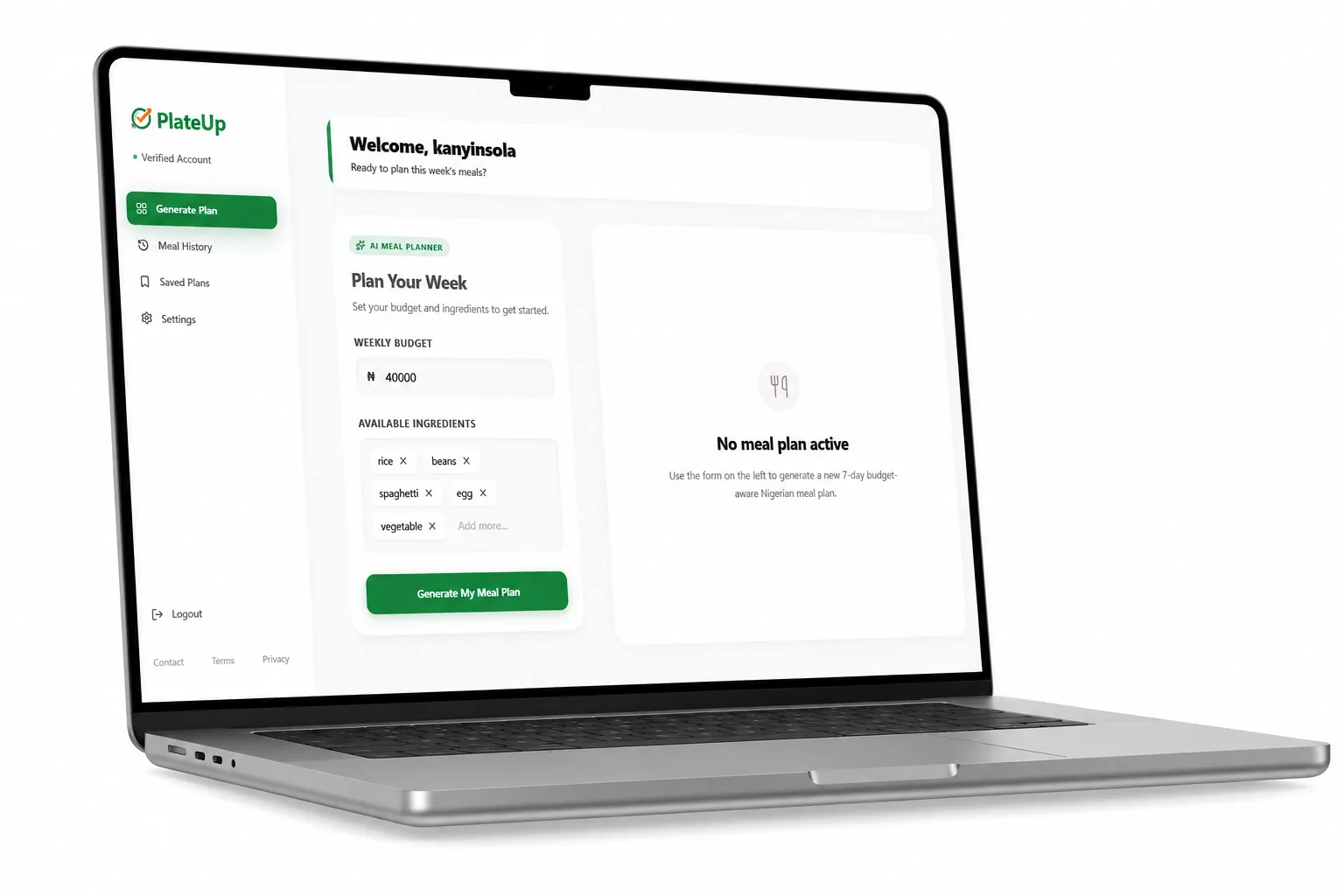
AI Plan Generation
Thecoredashboardinterfacewhereusersdefinetheirbudget,householdsize,andpreferencestoinstantlygenerateafullweekofpersonalized,Nigerian-firstmealplans.
- Generate personalized weekly meal plans
- Budget-aware recommendations
- Household preferences
- Nigerian-first recipes
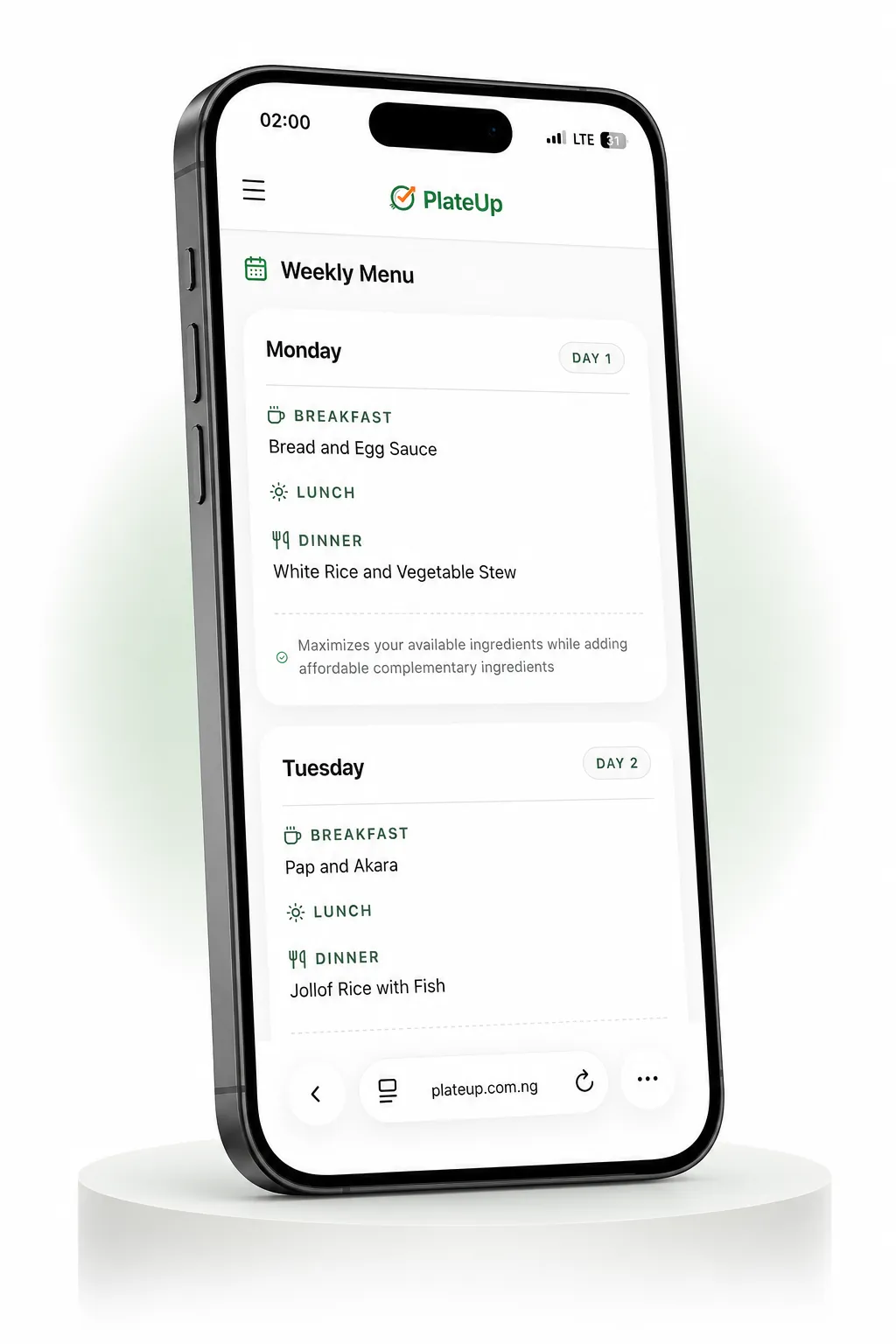
Generated Weekly Meal Plan
Aclean,accessiblemobileinterfacedisplayingtheAI-generatedbreakfast,lunch,anddinnerschedulewithseamlessoptionstoregenerateindividualmeals.
- AI-generated breakfast, lunch and dinner
- Easy regeneration
- Weekly planning experience
- Clean mobile interface
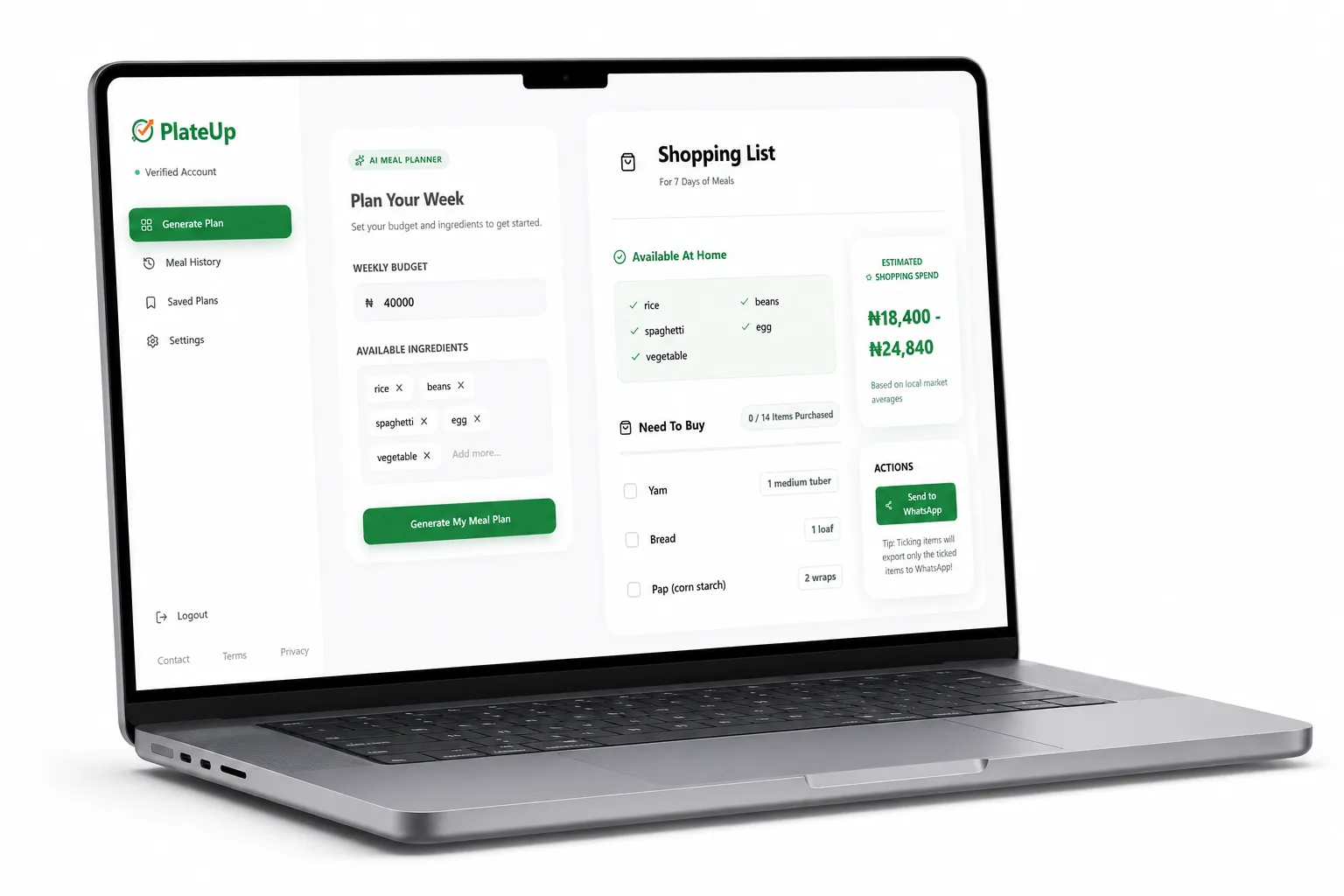
Smart Shopping List
Anintelligentdashboardviewthatautomaticallytranslatestheweeklymealplanintoastructured,cost-estimatedshoppinglistwhileaccountingforexistingpantryitems.
- Automatically generated shopping list
- Pantry-aware suggestions
- Ingredient quantities
- Cost estimation
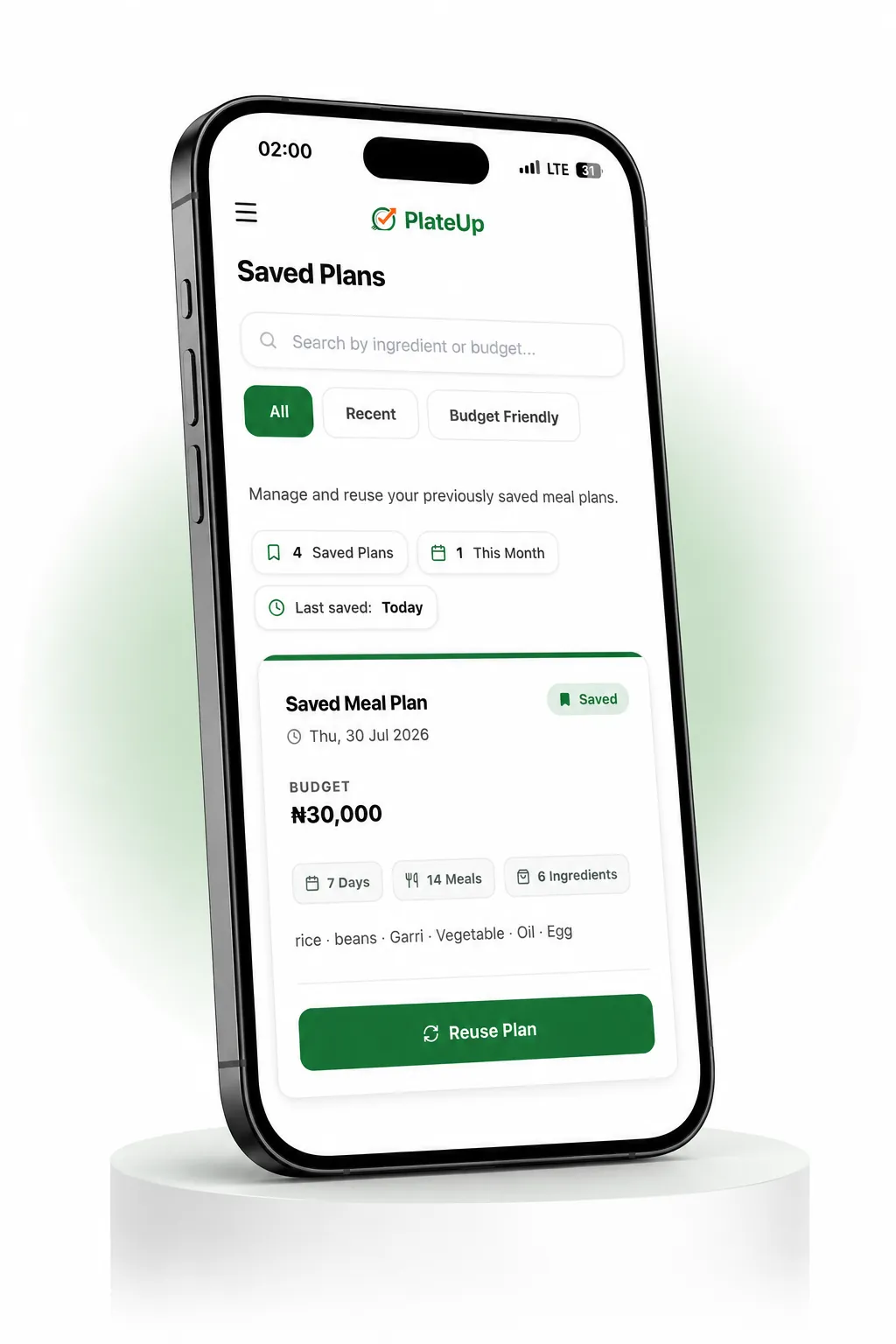
Saved Plans
Adedicatedmobilespacewhereuserscansecurelysavetheirfavoritemealplansandeasilyaccessthemanytimeforquickreuse.
- Save favourite meal plans
- Quick access library
- Easy reuse
- Offline access

Meal History
Acomprehensivedashboardviewthatallowsuserstobrowsetheirpastweeklymealplans,trackdietaryhabits,andmonitorlong-termplanningtrends.
- View previous plans
- Track dietary habits
- Long-term planning trends
- Data export
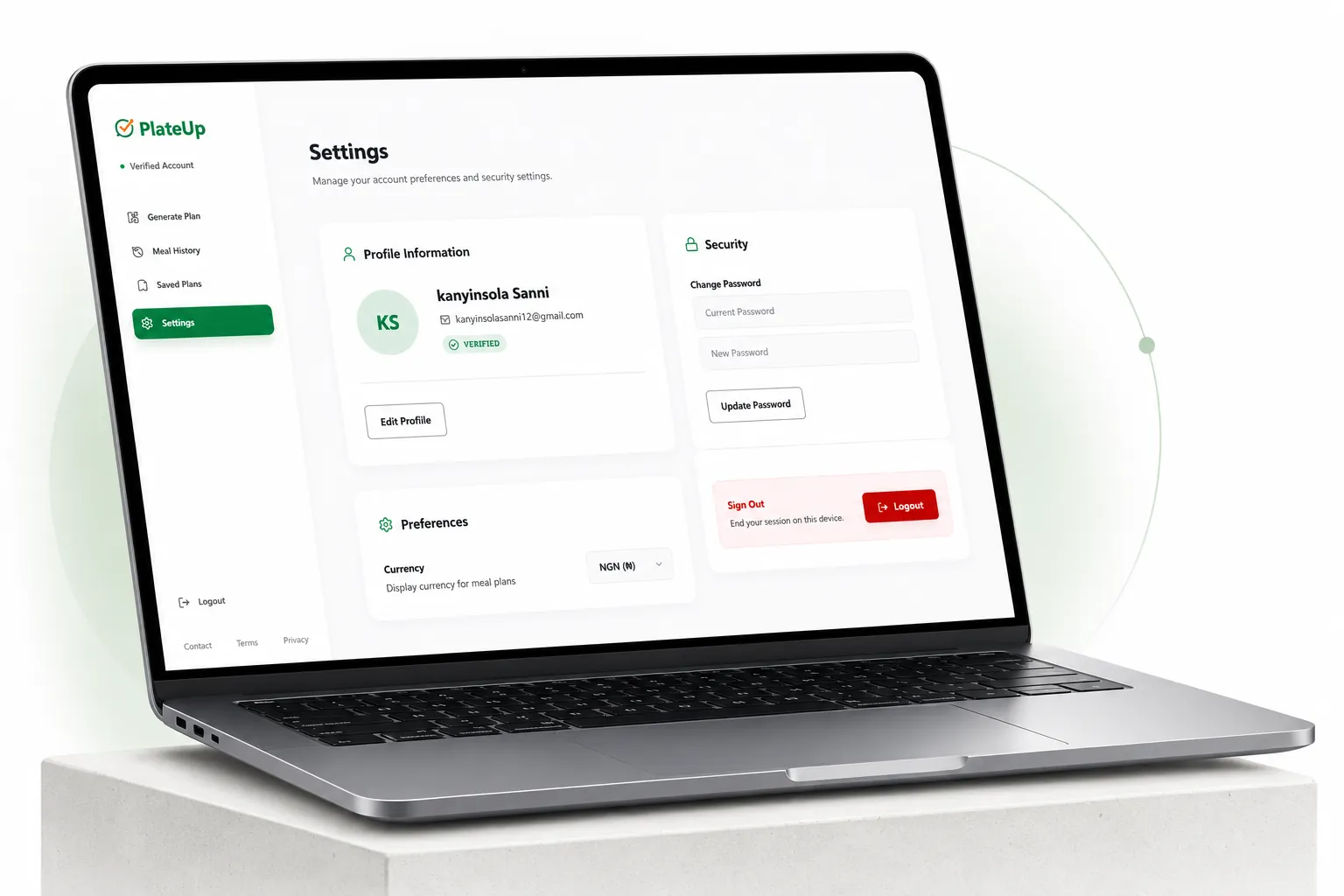
Settings
Essentialaccountmanagementtoolsallowinguserstopersonalizetheirdietaryconstraints,adjusthouseholdsize,andupdatebudgetpreferences.
- Dietary constraints
- Household size management
- Budget preferences
- Profile settings
Measuring Success
Simplify meal planning
Successful meal plan generation
Reduce grocery costs
Budget-aware meal recommendations
Reduce food waste
Pantry-aware shopping lists
Improve usability
Positive user feedback & repeat usage
Build user trust
Consistent and realistic AI outputs
Product Prioritization (MoSCoW)
Must Have
Essential features required for the MVP launch.
Should Have
Important enhancements planned after MVP validation.
Core Product Capabilities
AI Weekly Meal Planning
Generate personalized weekly meal plans based on user preferences.
Budget-Aware Planning
Create recommendations that respect the user's weekly food budget.
Pantry Awareness
Recommend meals using ingredients users already have before suggesting additional purchases.
Goal-Based Planning
Support multiple planning goals such as saving money and eating healthier.
From Research to Working Product
Rather than designing everything upfront, PlateUp evolved through an iterative product design process. Every stage built on insights from the previous one, allowing research, AI experimentation, user feedback, and development to continuously shape the final experience.
Discovery
Understanding the Problem
Focus Areas
Outputs
Key Outcome
Established a clear understanding of the users, their challenges, and the opportunity for an AI-powered meal planning assistant.
Define
Defining the Product Strategy
Focus Areas
Outputs
Key Outcome
Created a focused product scope centered on solving the most important user problems first.
Ideation
Exploring Possible Solutions
Focus Areas
Outputs
Key Outcome
Identified the simplest workflow capable of delivering personalized weekly meal plans.
Design System
Building a Consistent Experience
Focus Areas
Outputs
Key Outcome
Reduced design inconsistencies while improving scalability and development speed.
Prompt Engineering
Designing Better AI Outputs
Focus Areas
Outputs
Key Outcome
Produced reliable AI outputs tailored to Nigerian households instead of generic meal recommendations.
Development
Bringing the Product to Life
Focus Areas
Outputs
Key Outcome
Successfully transformed research and design into a working product.
Testing
Learning from Real Feedback
Focus Areas
Outputs
Key Outcome
User feedback directly influenced several high-impact product improvements.
Iteration
Continuous Improvement
Focus Areas
Outputs
Key Outcome
Each iteration brought the product closer to how Nigerian households actually plan meals.
Five Product Decisions That Changed PlateUp
Research uncovered several user problems that directly influenced the product architecture. Every major feature exists because it solved a validated user need.
Pantry-Aware Planning
AI LogicUsers often purchased ingredients they already had.
Make pantry ingredients a core AI input before generating meal plans.
Reduced duplicate purchases, lower grocery costs, reduced food waste.
Budget-First Planning
Budget PlanningMost meal planning tools ignore the user's actual budget.
Use the weekly budget as a primary constraint for AI meal generation.
More realistic recommendations, better spending control, personalized meal plans.
Flexible Meal Frequency
User ExperienceUser feedback showed that not everyone eats three meals daily.
Support both 2 Meals and 3 Meals per day.
Better personalization, more accurate shopping lists, improved budget allocation.
Practical Shopping Lists
ShoppingPrice-based shopping quantities quickly became outdated and inconsistent.
Replace prices with familiar Nigerian measurement units (pieces, cups, bunches, bottles).
Easier grocery shopping, greater user trust, more practical outputs.
AI Validation
AI ValidationRaw AI responses occasionally produced inconsistent meal plans.
Introduce an AI validation layer before displaying results to check budget, ingredients, and consistency.
More reliable recommendations, reduced AI errors, increased confidence.
From Product Strategy to Production
PlateUpgoesbeyondUIdesign—itisafullyengineeredAIproduct.Iarchitectedthecompletesystemfromthegroundup,movingfrominitialproductstrategytoaproduction-readyapplication.Thisrequireddesigningscalablebackendlogic,engineeringpreciseAIprompts,implementingstrictvalidationpipelines,andensuringthefinalexperiencewasfast,secure,andreliable.
Technology Stack
Frontend
A fast, responsive, and highly interactive user interface built with modern React patterns.
Backend
Secure and scalable serverless infrastructure powering the AI engine and business logic.
Database
Reliable relational data storage with a fully typed ORM for type-safe queries.
System Request Lifecycle
AI Planning Engine
The core intelligence of PlateUp. It takes five precise user inputs and constructs a structured prompt to generate highly personalized meal recommendations.
Planning Inputs
AI Validation Layer
Raw AI outputs are unpredictable. This strict validation pipeline ensures every generated meal plan is safe, accurate, and practically useful before reaching the database.
Validation Pipeline
Engineering Challenges Solved
AI hallucinations generating impossible meals.
Added a strict multi-step AI validation layer to check ingredients before saving.
Pantry items being duplicated in shopping lists.
Built a robust ingredient normalization algorithm to map semantic matches.
Unrealistic quantity outputs from the AI.
Implemented strict Nigerian-specific quantity validation rules (e.g. cups, bunches).
Generic, non-local meal recommendations.
Engineered deep Nigerian-specific context prompts to anchor the AI's generation.
Core Engineering Principles
Performance
Fast, streaming AI responses for an uninterrupted user experience.
Security
Secure authentication and protected, isolated user data storage.
Reliability
Multi-step AI validation ensuring predictable and safe outputs.
Scalability
Modular API architecture ready to handle increased user loads.
Complete Build Process
Building Beyond the MVP
"PlateUp became much more than an AI meal planner. It taught me that building successful AI products isn't about generating outputs—it's about designing systems users can actually trust. Every iteration, validation rule, and product decision moved the experience closer to solving real problems for Nigerian households."
Biggest Challenge
Making AI Reliable
The hardest part wasn't building interfaces—it was ensuring every AI-generated meal plan was practical, affordable, and realistic. That required prompt engineering, validation logic, and continuous refinement.
Biggest Lesson
Listen Before Building
The best product decisions came from user conversations, not assumptions. Feedback directly influenced meal frequency options, pantry awareness, shopping lists, and overall usability.
What I'd Build Next
Future Iterations
- Voice meal planning
- Pantry barcode scanning
- Shared family meal planning
- Grocery price comparison
- Nutrition tracking
Key Takeaways
Product Thinking
Research before features
AI Engineering
Validation matters more than generation
User Experience
Continuous testing beats assumptions
Personal Growth
From product designer to AI product engineer
"Great products aren't built in a straight line. They're shaped through research, experimentation, user feedback, and relentless iteration."
— My biggest takeaway from building PlateUp